Gaius Antonius Rufus
The Character
A look into the Roman military and its cultural exchange with the provinces, through the eyes of a young legionary.
Name: Gaius Antonius Rufus
Gender: Male
Age: 23
Status: Citizen
Family: Family is at home, Rufus is not married.
Occupation: Soldier
Time Period: 137 CE
Location: Bostra, Syria
Gaius Antonius Rufus, the Empire, and the Provinces: A Narrative Essay
by Kaden Kerr
A young man of 23, Gaius Antonius Rufus is a junior legionary, not holding any significant rank despite seeing combat with his legion in recent years. However, Rufus does not look like the common image of a legionary. Being far from the imperial core and facing many different threats, the legions in the east were forced to adapt to the challenges they were confronted with, be it the scorching heat or the beating hooves of a Parthian cataphract (a mounted archer). Though still part of the Roman world, this soldier is influenced by the world around him just as much as he influences it. This essay seeks to explore the unique relationship between a culturally influential empire and its provinces through the eyes of a young legionary, a lens through which to perceive not just how the Roman state pushed itself onto the provinces, but how they pushed back.
Still Roman, but not Roman
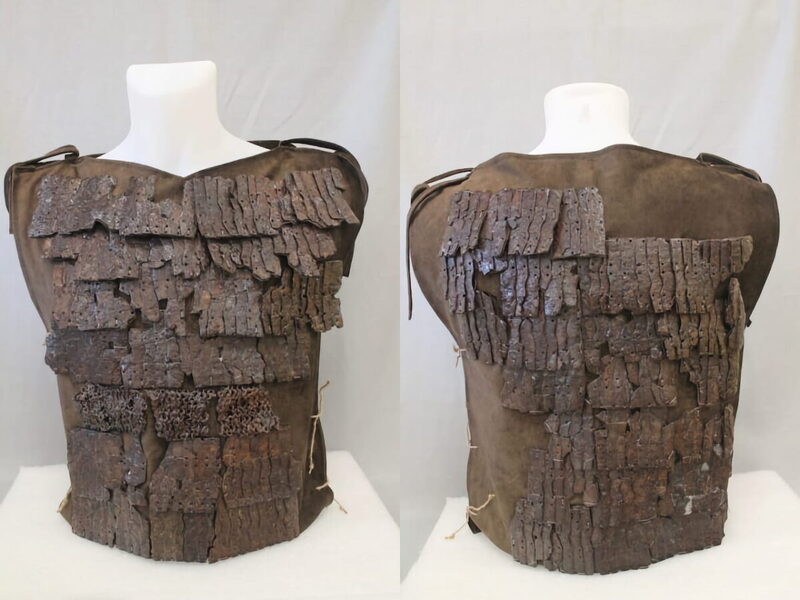
The crushing defeat of Marcus Licinius Crassus’s army by the Parthian Empire at Carrhae in 53 BCE left permanent scars on the Roman psyche and changed how the Romans fought and sustained themselves in the East. Excavations of the Dura-Europos site in eastern Syria reveal many stark differences, from what kind of clothing soldiers wore to the types (and frequency) of ranged weapons they employed. Rufus may still have possessed a pugio (dagger) and gladius (short sword), the hallmark of a Roman legionary, but he would have been trained to fight with an oval-shaped scutum (shield). He likely would have exchanged his lorica segmentata (Roman plate armor) for lorica hamata (chainmail) or lorica squamata (scale mail) like that shown in the image above. These alternatives would have been much more breathable than segmented plate armor, while still protecting the wearer from arrows and melée weapons. The junior legionary was far from well-paid, so Rufus would likely only have a set of moderate quality chainmail, alongside his gladius and an oval-shaped scutum better suited to the lightweight skirmishing common to the region’s engagements. Other armament could have included a hasta (thrusting spear) to counter cavalry, a sling, light javelins, or a composite bow. Beyond what he brought with him when first traveling to Syria, Rufus would have had to commission his equipment with his own pay through local blacksmiths and craftsmen and buy other goods locally. Though convenient in proximity, it would still not be cheap, and this monetary barrier to who could possess the right equipment for the job was a real concern for our young legionary.1
The evidence of how the Roman military changed its composition in the east is fragmented at best. No standardized list of what a soldier carried exists, so one must make informed inferences on what a soldier may have carried. What each legion sourced depended on what was available, making the army dependent on the raw materials of those they ruled. The conditions and threats the Romans faced in the east forced them to adapt in a unique way compared to the other major theaters that saw consistent fighting during the Imperial period. The martial cultures of the provinces in this region had a persistent and noticeable effect on how the Romans equipped themselves as well as the tactics they used, forging something more reminiscent of the later Greek Byzantine armies of the Medieval period.
Movement on the Eastern Frontier
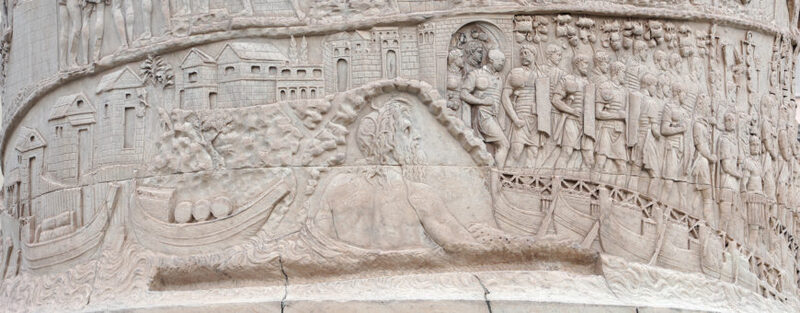
Flavius Vegetius Renatus, a later Roman military writer from the 5th c. CE, claims that a Roman legionary should be comfortable marching on foot up to thirty kilometers in six hours each day, and should be trained to march up to thirty-six kilometers per day at an extreme, but this training ideal would look much different when put into practice in the hot eastern provinces.2 Major roads existed that connected the prominent cities of the region but leaving them could see variable terrain causing slowdowns for the army. When in the field or on campaign, energy would need to be saved for constructing the unit’s temporary fort, foraging, and other necessary tasks. The demand on the average soldier during these marches would be incredible, as a legionary’s food, water, and military equipment had to be carried on his back, while marching in step for hours at a breakneck pace and only stopping to eat food. All this while the heat of the desert bore down on them and (if on campaign) the threat of attack loomed over every dune.
Rufus would be but one small cog in this very large machine. In a matter of days, a Roman legion could cover hundreds of kilometers, moving the military capacity and power projection capability of an army to an entirely new location in the time it took for their opponents to cover half that distance. This is how the Romans could move to respond to threats to their vast empire, and is the primary means through which Rufus would see and navigate his world: with one comrade in front of him, one to his left, one to his right, and one behind him, all marching forward in the way that we modern readers may “walk with a purpose”, only he would have done so with over fifty pounds of equipment and while sweating into his armor so much that it shone like new.
Life in the Provincial Legionary Base
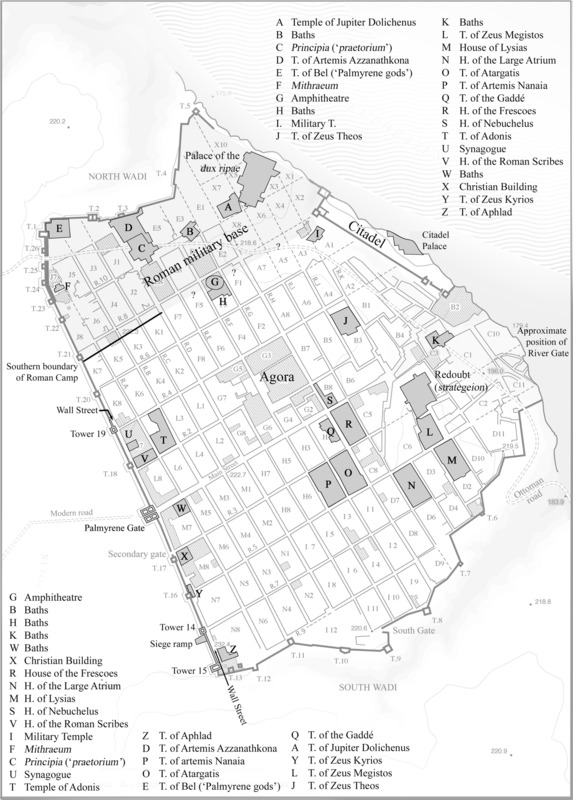
The base out of which Rufus’ legion operated was likely a main point of contact between soldiers and local peoples, and that interaction would have influenced Rufus. Shown above is a map of the site of Dura-Europos, a Roman fort further east of Bostra that was abandoned in 256 CE after its sack by the Sasanid Persians. Though not Rufus’ dwelling place, this fort offers the best-preserved glimpse into what life on the eastern frontier was like and sheds light on how the Romans stationed there interacted with the peoples and cultures that surrounded them. The need to adapt to the type of warfare the Parthians, and later Sasanids, engaged in meant a significant amount of auxilia troops (comprised of non-citizens from the provinces) trained with and served in the Roman military, providing experienced cavalry and missile units that Roman commanders integrated into their battle strategies.3
Like Dura-Europos, Bostra also contained a significant Jewish community during the period of Roman rule, alongside the many other cultures and religions of the region. Rufus would interact with these people daily, the Jewish population in particular being a major challenge to the worldview he would have held growing up back home, as they were exempt from sacrifice to the Imperial Cult, a religious and cultural practice that would remain a cornerstone of Rufus’ daily routine.4 The intercultural interactions would be constant, as Rufus and his legion honed their abilities alongside auxilia that would populate their camp, while the business and cashflow that the military population brought would ensure a bustling local economy and facilitate “off-duty” interactions. Rufus may learn the local language, come to worship local gods, or even form a relationship with a local woman and potentially have children. Though marriage was not permitted until 197 CE, evidence from Dura-Europos suggests informal marriages were not uncommon. These interactions had the potential to be both positive and negative but were a key part of how the ruler and the ruled interacted with each other.5
Archaeological evidence has lent credence the belief that the Romans routinely interacted and were heavily influenced by with the people over whom they ruled, though much of this comes from only a few sites, with further excavations being difficult due to the conflict intensity in the region today. The map of Dura-Europos shown above reveals shrines not just to Roman gods, but also Palmyrene gods and other local cults. However, this is the one of the only sources of evidence found that suggests this, so the degree to which this happened in the Roman East at large is still unknown. Unfortunately, the lived experience of someone like Rufus is also quite dubious, as his young age and lack of seniority means the experience of those like him did not survive. By observing the degree to which the Roman legions stationed in the region interacted with the local populations from the evidence that has been found so far though, logical assumptions can be made about how a young Roman man deposited on the far edge of his world would fit into this puzzle. Culture shock, hard experiences, and perhaps eventually becoming a “provincial Roman” would be likely experiences of someone like Rufus.
Why Rufus’ Story Matters Today
The Roman military as a tool of empire was not as monolithic as common perception suggests. Hard lessons and centuries of cultural exchange molded the Roman army in the east into something more resembling the later Eastern Roman armies than those that held the Rhine frontier in the west. Gaius Antonius Rufus is a fictional representation of thousands of Roman men who found themselves on the very edge of the world as they knew it, and how they would adapt or die in the face of harsh weather and harsher foes. To rule such a vast area of the world two millennia ago meant that a single image of empire was simply not possible, and the potential of a Roman man going off to serve in a far corner of the empire and becoming an entirely different person was possible in Rufus’ day. Romans served in the military for upwards of twenty-five years, and a generation’s worth of time passing is enough for significant cultural and military exchange between a single person and the place they now call home.
Sources and Further Reading
- Yale University Art Gallery: Dura-Europos Collection: https://www.jstor.org/site/yaleuniversitylibrary/yuag-dura-europos-collection/?so=item_title_str_asc&searchkey=1776122188280
- The Only Roman Armor of the “Lorica Squamata” Type Ever Discovered is Restored, https://www.labrujulaverde.com/en/2024/06/the-only-roman-armor-of-the-lorica-squamata-type-ever-discovered-is-restored/
- ORBIS: The Stanford Geospatial Network Model of the Roman World. orbis.stanford.edu
- Military Equipment – Tromontium Museum, https://hub.catalogit.app/trimontium-museum/folder/military-equipment-trimontium
- Digital Atlas of the Roman Empire - University of Gothenburg, https://imperium.ahlfeldt.se/
-
James, S. (2011). Rome & the sword : how warriors & weapons shaped Roman history . Thames & Hudson. ↩
-
Vegetius Renatus, F. (1996). Vegetius: epitome of military science: Vol. 16. (2nd ed., revised.). Liverpool University Press. https://doi.org/10.3828/9780853239109 ↩
-
Haynes, I. P. (2013). Blood of the provinces: the Roman auxilia and the making of provincial society from Augustus to the Severans (First edition.). Oxford University Press. https://doi.org/10.1093/acprof:oso/9780199655342.001.0001 ↩
-
Reasoner, M. (2013). Roman Imperial Texts [electronic resource] : A Sourcebook . Fortress Press. ↩
-
Ivleva, T. (2018). Embracing the provinces : society and material culture of the Roman frontier regions (T. Ivleva, J. de Bruin, & M. Driessen, Eds; 1st ed.). Oxbow Books. ↩