Publius
The Character
Publius is a 33-year-old free man living in Hispania Tarraconensis, He is not wealthy, but he is not enslaved. He survives by transporting goods inland using mules and a wagon.
Name: Publius
Gender: Male
Age: 33
Status: Citizen
Family: Single man
Occupation: Cart Driver
Time Period: 360 CE
Location: Tarraco, Hispania
The Life of Publius
by Colton Elison
When people think about ancient Rome, they often imagine dramatic moments, assassinations, emperors rising and falling, and political conspiracies. Events like the murder of Julius Caesar dominate both historical writing and modern media. But for most people living in the Roman Empire, life was not centered on the Senate or the palace. It was shaped by something far less dramatic and glamorized, how power filtered down into everyday survival. This project asks a different question: What did Roman power struggles mean for ordinary people who were not part of them? To explore this, we follow a reconstructed figure Publius, a mule driver in Roman Spain. His life helps us examine how violence, spectacle, and control affected people who had little political power but still lived under its consequences.
Meet Publius: A Life always on the move
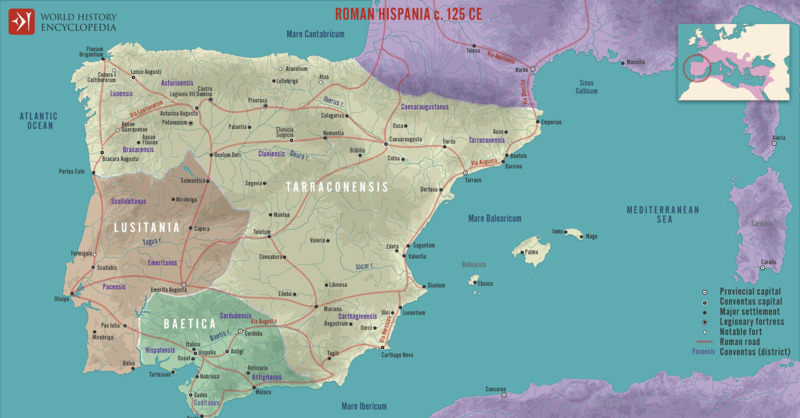
Publius is a 33-year-old free man living in Tarraco, which is in Hispania Tarraconensis, or “current day Spain”1. He is not wealthy, but he is not enslaved, he survives by transporting goods inland using his mules and a wagon. His life is defined by movement, he travels between cities inland such as Tarraco to Caesaraugusta. These journeys can take days and require careful planning, savings, and risk management. Roman road systems connected distant provinces, goods were regularly transported by animal driven carts, and non-elite laborers played essential roles in trade throughout the entirety of Rome. Using our character’s background, we can then infer that Publius likely relied on experience rather than formal education. He gathered information about weather, routes, and dangers before traveling and this was important to do because his income depended on successful deliveries.
Movement and Risk: The Geography of Survival
A regular work route for Publius’ is Tarraco to Caesaraugusta. In July it takes roughly 3.9 days, covering 260 kilometers. His trip by carriage with donkeys would cost about 8 denarii (silver) equivalent to 32 bronze sestertii. This is not a cheap journey for someone with his status and wealth so each journey needs to be taken very cautiously. He has to account for weather, terrain, bandits, Roman army presence, and many other factors that could be dangerous to him.
Visual Evidence: Labor on the Roman Road
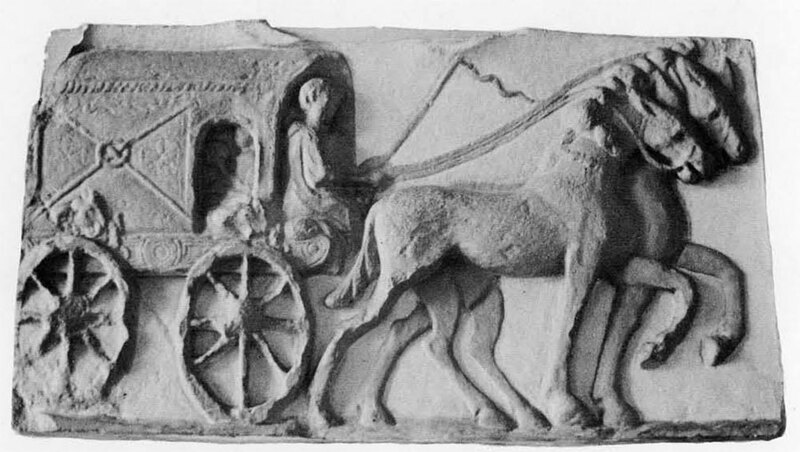
Roman carvings and depictions of carts and drivers, such as those found in Pompeii, show how goods and people moved across the empire.2 These images highlight both infrastructure and labor. We know Rome had an extensive road network and people like Publius were the backbone of much of the economy by keeping the movement of trade and transporting goods alive. The Roman Empire was sustained not just by conquest but by systems that structured everyday life across its territories3. The extensive road networks and laborers like Publius are often underappreciated in Roman history. However, these visual sources also have limitations. While they depict the presence of carts, animals, and roads, they do not show the risks, exhaustion, and uncertainty involved in this work.
Violence and Control: Power Beyond the City
Roman power was not only expressed through laws or armies. It was also maintained through violence and spectacle. Public punishments, military presence, and displays of authority reinforced control across the empire including in the provinces. We know that often Rome used public violence to enforce order, provincial regions were under imperial control, and that military and administrative changes could disrupt local life. Offenses like murder and treason were long time parts of Roman criminal law. Any accused could be subject to execution which contributed to potential false accusations leading to executions of rivals4. While we can’t know for sure we can infer that Publius may have witnessed or heard about punishments and such events may have reinforced his awareness of authority. Publius would not likely read official decrees or participate in political debates. Instead, news reached him through travelers, merchants, and roadside conversations. Events like the assassination of Julius Caesar or the rise of new emperors would likely arrive as rumors, not formal announcements. This matters because it changes how power is experienced. For elites, power struggles are strategic and intentional, but for someone like Publius, they are uncertain disruptions that he has no control over.
Roman Afterlives: Why This Still Matters
Modern portrayals of Rome such as films, games, and books focus heavily on emperors, gladiators, and dramatic violence. These stories shape how we imagine the Roman world with power appearing centralized and dramatic. Ordinary people are often invisible and violence is treated as a spectacle, not a structure. Historians like Kostas Vlassopoulos expand the definition of politics beyond elite institutions, allowing us to see how power shaped the lives of ordinary individuals. He explains “The agrarian laws of Sparta and Rome played a particular role as models for how a political community ensured the rule of virtue for its citizens in the past.”5 Publius’ story challenges modern assumptions by shifting the focus away from elite actors and toward everyday experience. He continued to do his role as a citizen of the empire. It reminds us that most people experienced Rome indirectly and the stories we hear are not the reality of everyday life.
Conclusion: Carrying the Weight of Empire
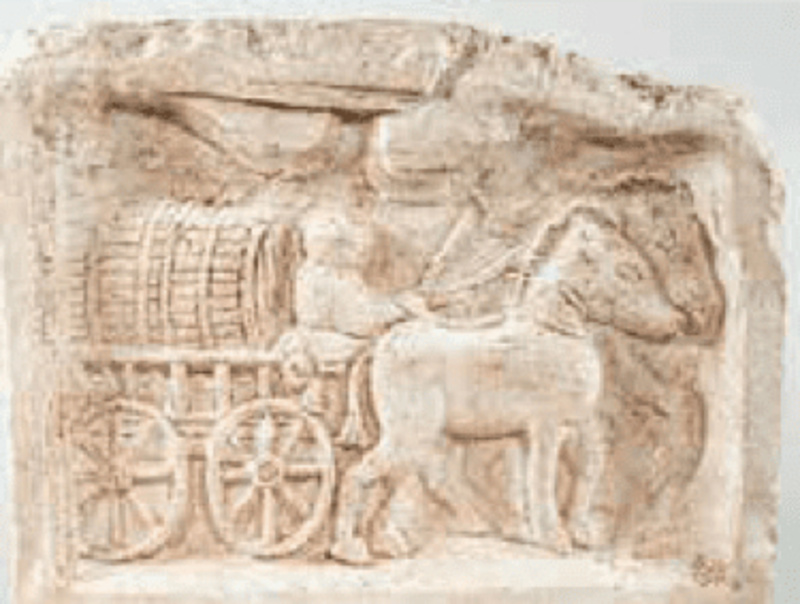
Publius does not fight in political struggles, he does not shape imperial decisions, he does not appear in historical narratives, and yet, he carries the empire by doing his job along with many others who go unnoticed by history. By doing his job he moves goods throughout the empire helping the economy and cities function.6 His life shows that Roman power was not only about spectacle and violence at the top, but also about control embedded in everyday life. Even without direct involvement, he lived within its reach. He and many others lived their life with virtue and hard work, and were the unsung heroes of the Roman empire itself.
AI disclosure: AI was used for the purposes of Grammar, Formatting and outlining this project.
Sources
- Davidson, K. (n.d.). Mules in Antiquity. Lucky Three Ranch. Retrieved 4 30, 2026, from https://www.luckythreeranch.com/tag/mules-in-antiquity/
- Matthews, K. D. (n.d.). Expedition Magazine | The Embattled Driver in Ancient Rome. Penn Museum. Retrieved May 5, 2026, from https://www.penn.museum/sites/expedition/the-embattled-driver-in-ancient-rome/
- Netchev, S. (2023, February 1). Map of Roman Hispania c. 125 CE. World History Encyclopedia. Retrieved May 5, 2026, from https://www.worldhistory.org/image/16928/map-of-roman-hispania-c-125-ce/
- Tellegen-Couperus, O. (2025, May 21). Read Online Download Book Add to Bookshelf Share Link to Book Cite Book A Short History of Roman Law. ProQuest Ebook Central. Retrieved May 5, 2026, from https://ebookcentral.proquest.com/lib/uidaho/detail.action?pq-origsite=primo&docID=166661
- Vlassopoulos, K. (2009). Politics: Antiquity and Its Legacy. Bloomsbury Publishing.
- Woolf, G. (2012). Rome : an empire’s story. Pro Quest E-book Central. Retrieved May 5, 2026, from https://ebookcentral.proquest.com/lib/uidaho/reader.action?docID=916041&c=RVBVQg&ppg=3
- “ORBIS: The Stanford Geospatial Network Model of the Roman World,” Stanford University.
Image Sources
- Netchev, S. (2023, February 1). Map of Roman Hispania c. 125 CE. World History Encyclopedia. Retrieved May 5, 2026, from https://www.worldhistory.org/image/16928/map-of-roman-hispania-c-125-ce/
- Matthews, K. D. (n.d.). Expedition Magazine | The Embattled Driver in Ancient Rome. Penn Museum. Retrieved May 5, 2026, from https://www.penn.museum/sites/expedition/the-embattled-driver-in-ancient-rome/
- Davidson, K. (n.d.). Mules in Antiquity. Lucky Three Ranch. Retrieved 4 30, 2026, from https://www.luckythreeranch.com/tag/mules-in-antiquity/
-
Netchev, S. (2023, February 1). Map of Roman Hispania c. 125 CE. World History Encyclopedia. Retrieved May 5, 2026, from https://www.worldhistory.org/img/c/p/2400x1254/16928.png ↩
-
Matthews, K. D. (n.d.). Expedition Magazine | The Embattled Driver in Ancient Rome. Penn Museum. Retrieved May 5, 2026, from https://www.penn.museum/sites/expedition/the-embattled-driver-in-ancient-rome ↩
-
Woolf, G. (2012). Rome : an empire’s story. Pro Quest E-book Central. Retrieved 5 5, 2026, https://ebookcentral.proquest.com/lib/uidaho/reader.action?docID=916041&c=RVBVQg&ppg=3 ↩
-
Tellegen-Couperus, O. (2025, May 21). Read Online Download Book Add to Bookshelf Share Link to Book Cite Book A Short History of Roman Law. ProQuest Ebook Central. Retrieved May 5, 2026, from https://ebookcentral.proquest.com/lib/uidaho/detail.action?pq-origsite=primo&docID=16 ↩
-
Vlassopoulos, K. (2009). Politics: Antiquity and Its Legacy. Bloomsbury Publishing. ↩
-
Davidson, K. (n.d.). Mules in Antiquity. Lucky Three Ranch. Retrieved 4 30, 2026, from https://www.luckythreeranch.com/tag/mules-in-antiquity/ ↩