Gaius Lartius Priscus
The Character
Gaius Lartius Priscus was a former gladiator who rose to become a lanista in the Roman Empire. Once marked by the stigma of infamia, he navigates a rigid social hierarchy while exercising control over the training and lives of his gladiators. His story reflect the structured power embedded within Roman gladiatorial spectacle.
Name: Gaius Lartius Priscus
Gender: Male
Age: 37
Status: Freedperson
Family: Married, no children
Occupation: Lanista
Time Period: 84 CE
Location: Capua, Italy
Establishing Order in the Arena: Introducing Gaius Lartius Priscus
by Addee Wheatley
Roman gladiatorial games are often remembered as chaotic spectacles of violence, but in reality, they were carefully controlled performances shaped by figures like the lanista. The lanista’s authority extended over most aspects of a gladiator’s life. These ideas become clearer when viewed through the life of Gaius Lartius Priscus, a fictional character based on scholarly research. His life reflects what is known about gladiators and lanista in the Roman Empire. Through tellings of what is known about the system of power and control that defined Roman spectacle.
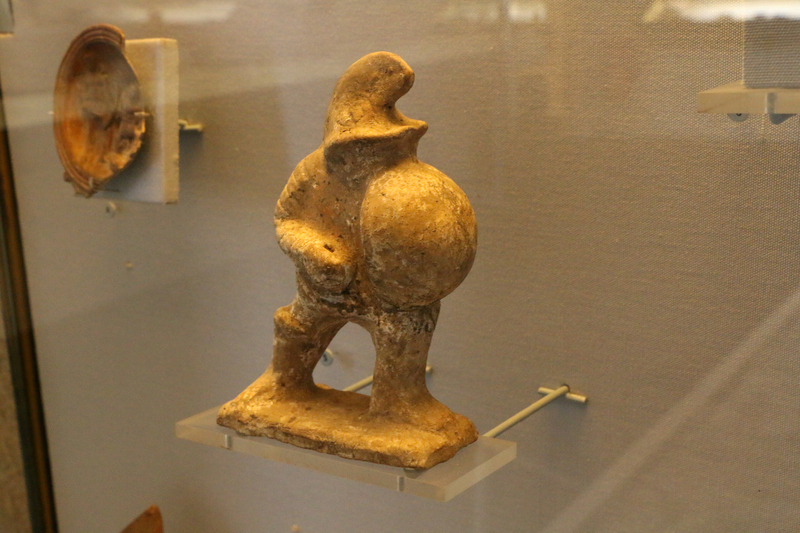
Gaius Lartius Priscus, like a few other lanista, was of freedman status.1 In his early life, he was believed to have fought as a gladiator at a colosseum in the city of Bovianum. After being freed from servitude through his success as a gladiator, he is believed to have moved to Capua, a city well known for its gladiatorial schools or ludus.2 The ludus in this area was known as Neronian Training schools, meaning they were created during the Neronian era 54-68 CE. 3
Infamia and Social Stigma
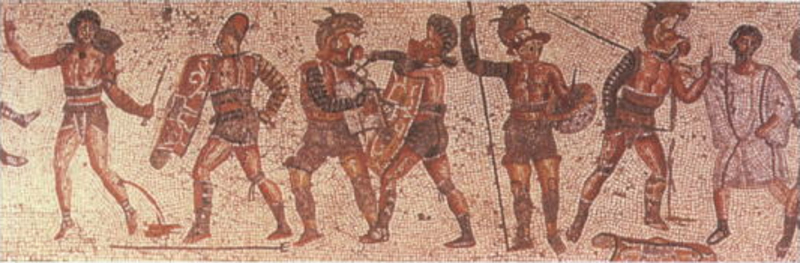
Although viewed better than gladiators, lanista was still believed to be infames.4 Infamia was a social status that was associated with people who carried immoral or “un-Roman” professions. Any profession where one would use their body as a tool for their work would fall under infamia. Examples of these jobs include pimps, actors, gladiators, lanista, etc. Lanista are believed to fall under this demographic because they bought and sold people. This status was also given to those that were convicted criminals. Gladiators were also marked as infamia because they performed much like actors. In addition, gladiators were often either criminals or slaves. The term infamia shows the importance of status and reputation within Roman society. For Gaius Lartius Priscus, this meant that even after transitioning to a lanista, his identity remained socially marked and limited.
The Systematic Organization of Gladiatorial Combat
Evidence of the first munera, or gladiatorial combat, appeared in 264 BC.5 In the beginning, many gladiatorial bouts were believed to be performed as part of funeral arrangements. Romans believed that blood spilt during these funerary arrangements would help the passage of its leaders.6 During the start of the Roman Empire, the purpose of these bouts shifted. It is believed that the combats began to represent the central authority of Augustus and helped legitimize his rule. This continued to transform over the course of the empire, and the gladiator became a symbol of idealized military power.
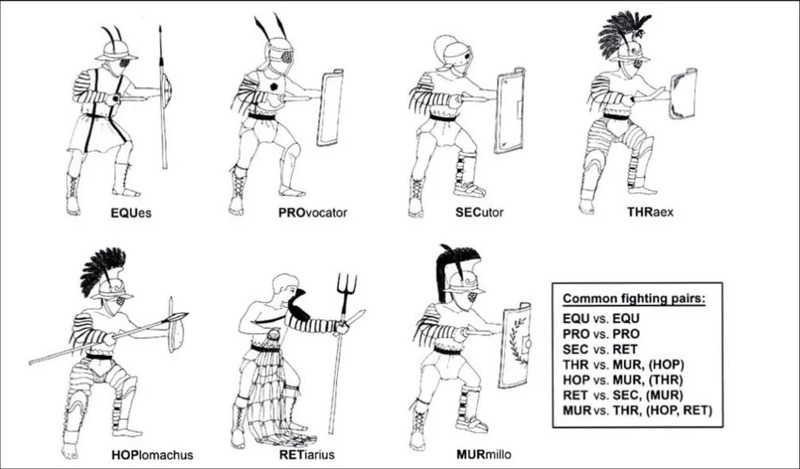
Within the conflicts there were different gladiator types that would appear, such as the Murmillo, Retiarius, Secutor, and Thraex. Each of the classes would fight with different weapons and were provided with different armor. For example, the Murmillo possessed a heavy shield and a fish shaped helmet, but the Retiarius has a net, trident and light armor. Examples of these types of gladiators can be seen in the image below in addition to the likely fighting pairs.
The topic of how classes were assigned is often debated by historians. One belief is that types of gladiators are assigned based on status. The idea that gladiators with heavier armament is given to those that volunteer versus slaves being assigned to lightly armored.7 Others believe that it is more of a choice based on what type is preferable to the gladiators’ fighting style.
Hierarchy and Control in the Roman Arena
The transition of gladiator to lanista shows how control was embedded within spectacles performed in the Colosseum. There is a clear hierarchy of those that had power within the colosseum and what the spectacles were transformed to represent. Those that fought within the gladiatorial bouts were at the bottom, most of them being criminals and infamia. Even the next layer up, lanista, was not viewed much better still being labeled as infamia. Although the lanista were able to have control over groups of gladiators or familia.8 Lanista would train and dictate most of the daily life of their familia. For the games to take place, gladiators would be rented out to the editores. These individuals were believed to be local elites that were responsible for funding and organizing the games. In addition to funding the games, they often would own the ludus that the gladiators would train at. Editores were also able to determine the outcome of a draw within the bouts.


Roman Spectacle as a System of Power
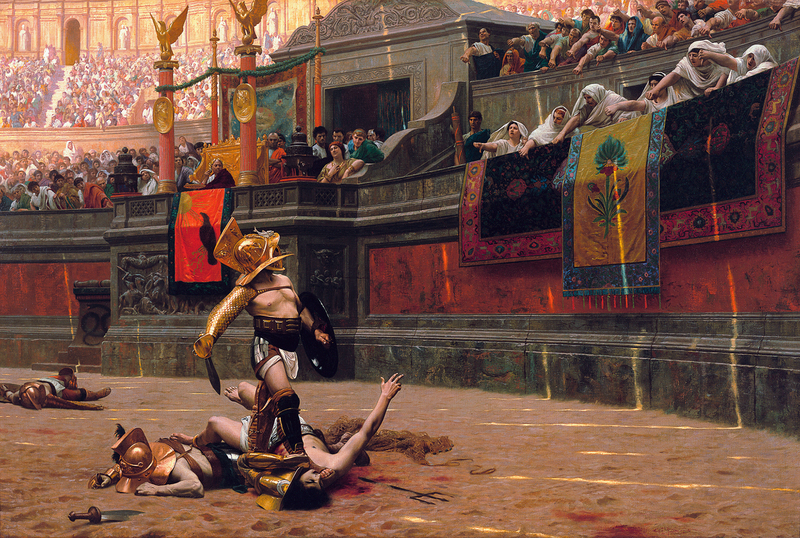
Gaius Lartius Priscus’ story helps display that Roman spectacle was not just entertainment, but a structured system of power that helped shape society. Enabling leaders to show their control to those in the arena. Editores could show this by having lavish bouts for those attending to watch or by determining the outcome of the conflicts. The aspect of gladiator and lanista relationship shows how a certain class can have control over a group of people. The matchups of fighters also point to being heavily controlled to potentially favor one outcome or another. All of this information helps highlight how spectacles were used as a form of control within the Roman Empire.
Bibliography
-
Blood in the Arena the Spectacle of Roman Power. 2023; University of Texas Press, n.d.
-
Christesen, Paul. A Companion to Sport and Spectacle in Greek and Roman Antiquity. 2014; Wiley Blackwell, n.d.
-
Lee, Brice. Aspect of Ancient Institutions and Geography: Studies in Honor of Richard J. A. Talbert. 2014; Brill, n.d.
-
MAN- Statuette de Glaidateur; Wikimedia Commons. Accessed May 5th 2026. https://commons.wikimedia.org/wiki/File:MAN_-_Statuette_de_Gladiateur_-_Thrace.jpg
-
Jean-Leon Gerome Pollice Verso; Wikimedia Commons. Accessed May 5th 2026. https://commons.wikimedia.org/wiki/File:Jean-Leon_Gerome_Pollice_Verso.jpg
-
Gladiators from the Zilten Mosaic; Wikimedia Commons. Accessed May 5th 2026. https://commons.wikimedia.org/wiki/File:Gladiators_from_the_Zliten_mosaic.jpg
-
Gladiator Types and Common Fighting Pairs; Research Gate. Accessed May 5th 2026. https://www.researchgate.net/figure/Gladiatorial-types-and-common-fighting-pairings-2-nd-3-rd-c-AD-Source-Kanz-and_fig2_353947174
-
Christesen, A Companion to Sport and Spectacle in Greek and Roman Antiquity, 580. ↩
-
Blood in the Arena the Spectacle of Roman Power, 14. ↩
-
Lee, Aspect of Ancient Institutions and Geography: Studies in Honor of Richard J. A. Talbert, 129. ↩
-
Lee, Aspect of Ancient Institutions and Geography: Studies in Honor of Richard J. A. Talbert, 129. ↩
-
Blood in the Arena the Spectacle of Roman Power. ↩
-
Blood in the Arena the Spectacle of Roman Power. ↩
-
Lee, Aspect of Ancient Institutions and Geography: Studies in Honor of Richard J. A. Talbert. ↩
-
Christesen, A Companion to Sport and Spectacle in Greek and Roman Antiquity, 38.8 ↩