Labor Riots of Butte
The Place
Location: Southwest Montana along interstate 90, Montana
Subjects: Butte; riots; unions; anti-war
Time: circa 1914
Labor Riots of Butte
by Eoin Gleeson
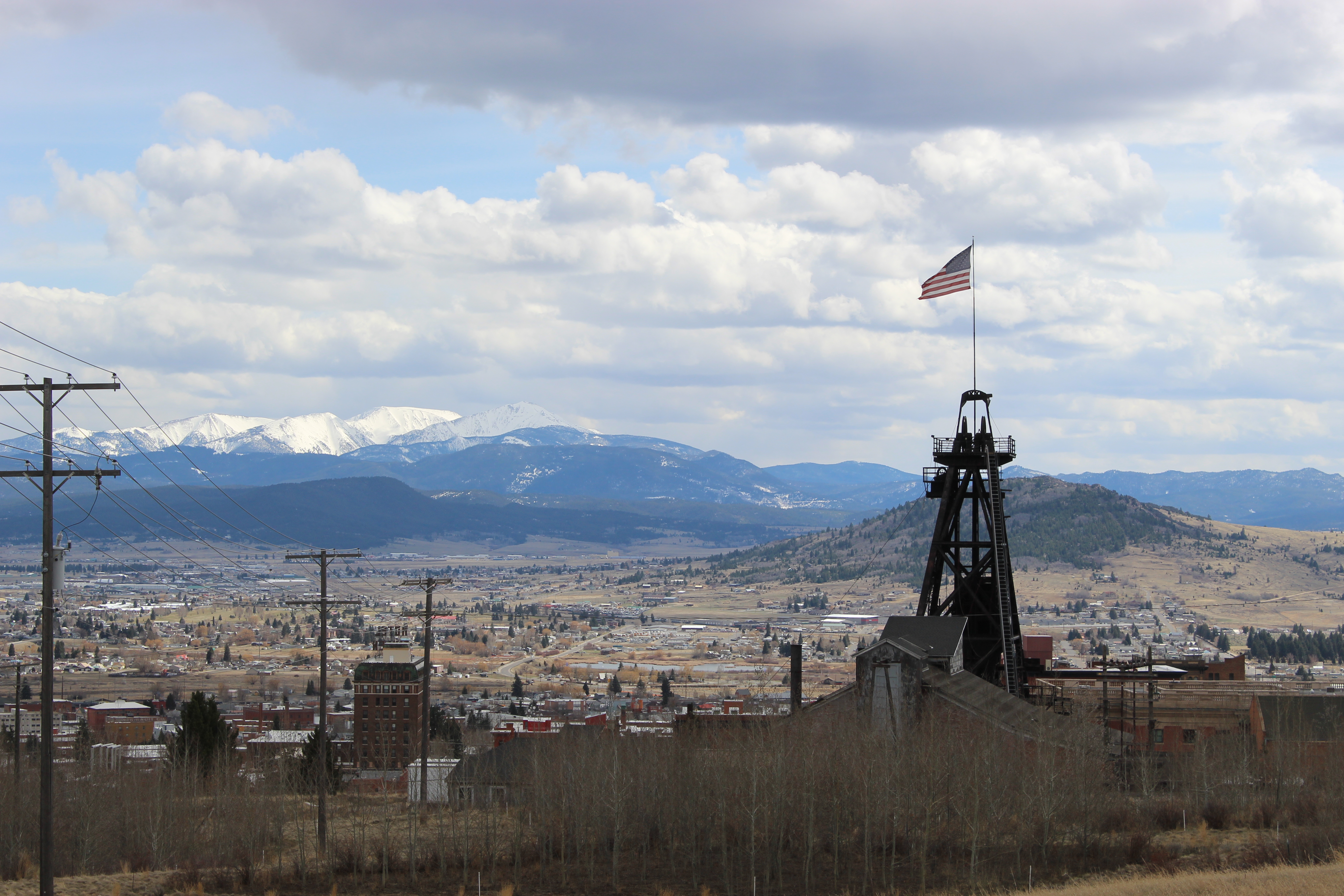
Come to Butte for the headframes and open-pit mines; stay for the story of labor riots, anti-war activism, and martial law. Driving into Butte on Interstate 90 clearly presents the driver with the remnants of a boomtown. Mining headframes stand distinct in the skyline and are even illuminated at night. The copper-colored hills at the Berkeley Pit make obvious the legacy of open pit mining. Yet the story of Butte goes beyond what can be visually derived from the standing monuments to mining.
Walking the streets of downtown Butte, you can see how this was once a very American city with its mining prowess. North-south streets named after states intersect with east-west streets named after minerals. Butte grew into a premier American mining city through the large demand for copper which lay below the ground; the Anaconda Mining Company monopolized the mining industry in Butte, leading to it becoming one of the largest mining companies by the early 20th century.1 While profit blessed the company as it extracted abundant copper to meet growing demand, dismal working conditions damned the workers.
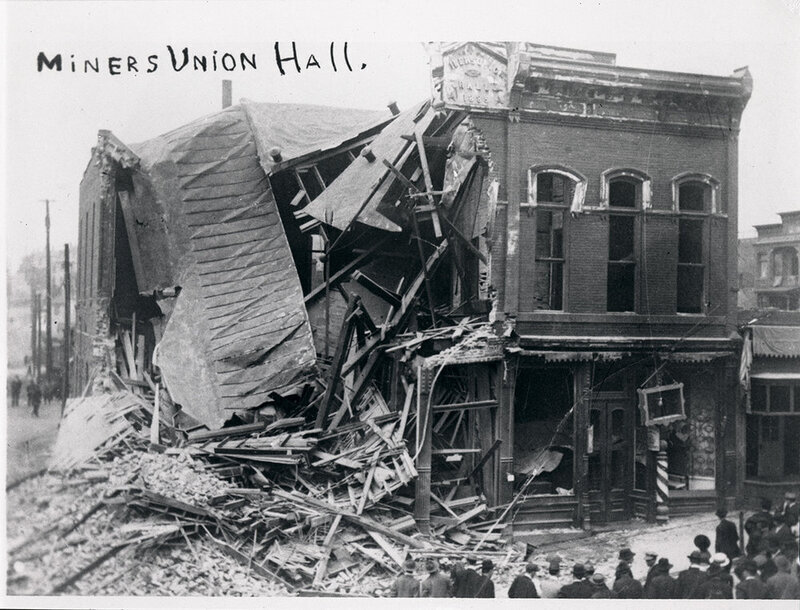
Unionization grew in Butte in the 1890s, shaped by workers’ discontent with their life-threatening working conditions; but by the time the Anaconda Company had reached its peak prowess, the unions were fracturing. Ethnically motivated fears of economic competition led to the ostracization of Chinese immigrants from mining. The union further organized a boycott of Chinese businesses.2 These ethnic disputes, along with political fracturing and anti-union manipulation by the Anaconda Company,3 set the stage for the volatile state of the union. Volatility would become hostility in 1914. By then, miners had finally had enough of a lack of increased compensation, despite the increased value of the minerals they extracted. During annual union celebrations that June, the Miners Union Hall became the victim of a parade turned riot; with little reason to celebrate the union, frustrations were taken out on its headquarters. Though ravaged by the furious crowd, the building nonetheless remained standing. However, the subsequent failed attempt at mediation between leadership and workers caused greater chaos: shots were fired; people fled the building in a panic; and whiskey met with dynamite.4
The Miners Union Hall was destroyed by the resulting explosion. In response to the deteriorating situation in Butte, the Montana National Guard was mobilized under the declared state of martial law. Arrests by military marshals came upon the union leaders for their part in the quarrel; riflemen lined streets and roofs, and workers were searched for dynamite when leaving the mines.5 Troops remained in Butte until November, by which the union had lost its recognition from the Anaconda Company due to its inability to “enforce peaceful jurisdiction over their men.”6
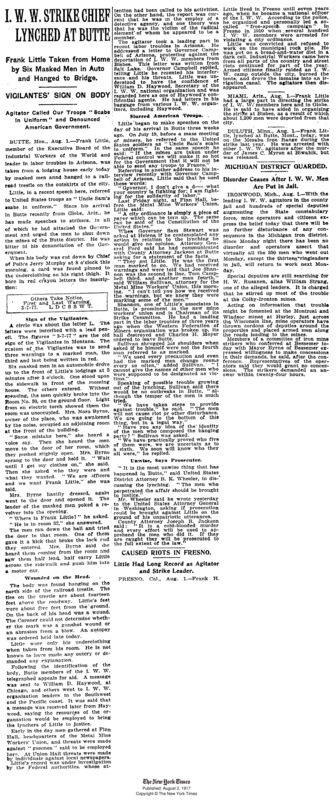
Unrest plagued Butte beyond 1914, with tensions growing further into the decade as the United States entered the World War I. National Guard troops mobilized under another declared state of martial law in June 1917 due to the anti-war protests in the city.7 While arson colored the 1914 riots, the 1917 violence delivered murder. Frank Little, leader of the Industrial Workers of the World leader, came to Butte, where the value of minerals to the war effort sparked anti-war protests. Little characterized the war as the capitalist slaughter of the working class, but he did not live long enough to do much more in Butte, as he would be lynched in a gruesome act of political violence and intimidation. Dragged out of bed in the middle of the night, Little’s body was hung on a bridge, beaten and bruised, with the following message on him: “others take notice, first and last warning.”8 An air of mystery surrounds this murder: the perpetrators were never identified.9
Works Cited
-
“Butte-Anaconda Historic District, Montana.” National Park Service, www.nps.gov/places/butte-anaconda-historic-district.htm. ↩
-
Schneider, Carrie. “Remembering Butte’s Chinatown.” Montana: The Magazine of Western History, vol. 54, no. 2, 2004, pp. 69. JSTOR, http://www.jstor.org/stable/4520610. ↩
-
Munday, Pat. Butte Mining, 1864 – 2005: A brief cultural and environmental history. Montana Tech, 2005, p. 3, web.archive.org/web/20161020210748/www.mtech.edu/academics/clsps/ptc/sciencesocietysuperfund/pubs_presentations/butte_mining_history.pdf. ↩
-
Everett, George. “When Toil Meant Trouble: Butte’s Labor Heritage.” ButteAmerica.com, web.archive.org/web/20160601213708/www.butteamerica.com/labor.htm. ↩
-
“BUTTE UNDER MARTIAL LAW.; Four Leaders of New Union Arrested by Military Authorities.” The New York Times, 3 Sept. 1914, p. 6, www.nytimes.com/1914/09/03/archives/butte-under-martial-law-four-leaders-of-new-union-arrested-by.html. ↩
-
Swindlehurst. First Biennial Report of the Department of Labor and Industry. Helena, MT, State of Montana, 1914, pg. 30-31, books.google.com/books?id=gUU_AQAAMAAJ&dq=butte+union+intitle%3Abiennial&pg=PA25#v=onepage&q=butte%20union%20intitle%3Abiennial&f=false. ↩
-
“SOLDIERS ROUT BUTTE RIOTERS; Montana Town Practically Under Martial Law After AntiDraft Demonstration.” The New York Times, 6 June 1917, p. 1, www.nytimes.com/1917/06/06/archives/soldiers-rout-butte-rioters-montana-town-practically-under-martial.html. ↩
-
“I. W. W. STRIKE CHIEF LYNCHED AT BUTTE.” The New York Times, 2 Aug. 1917, timesmachine.nytimes.com/timesmachine/1917/08/02/102355431.pdf. ↩
-
Carroll, Rory. “The mysterious lynching of Frank Little: activist who fought inequality and lost,” The Guardian, 21 Sept. 2016, www.theguardian.com/us-news/2016/sep/21/mysterious-lynching-of-frank-little-equality-activist. ↩
Primary Sources
State of Montana First Biennial Report of the Department of Labor and Industry 1913-1914

Excellent narrative of the events in butte during that year, including causes of riot and outcome. Details grievances of workers and the response from the state, martial law.

IIW Strike Chief Lynched at Butte
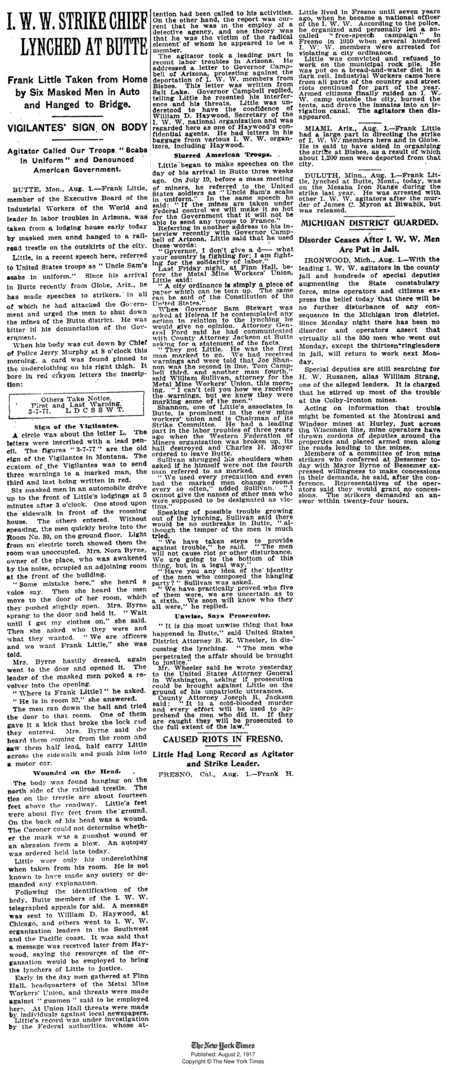
This article reveals the state of unrest in butte over labor and war, with this murder marking a particularly dark moment in this period. Being featured in a nationally read newspaper indicates the prominence of Butte within the country, that it would be covered by this publication. Showcases Butte as a hotbed of not just the labor movement in America but also of anti-war sentiment.
Miners Union Hall
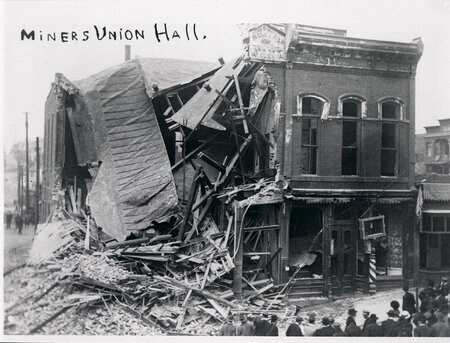
Seeing a photo of the damage shows the extent of the riots. These destructive riots led to martial law in Butte. Additionally, this event influenced the Anaconda Mining Company to no longer recognize the Butte Miners Union.
Butte Original Mine Headframe April 2025
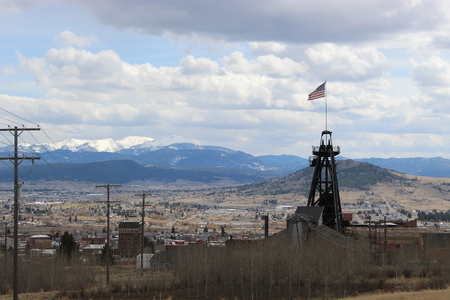
Taken during one of my excursions out to Butte for a different project. The mining headframe topped by an American flag visualizes the history of Butte. Though no longer operational, this mining headframe remains as a reminder of the American industrial powerhouse that Butte once was.
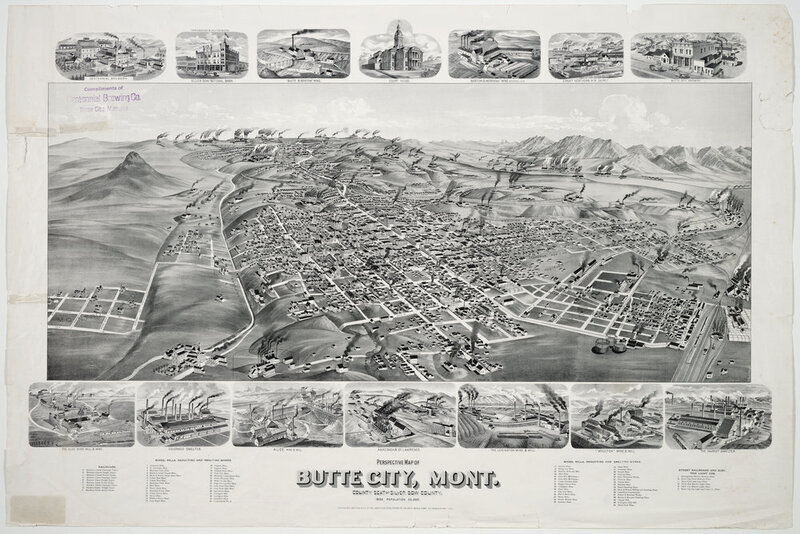
Perspective map of Butte City, Mont.: county seat of Silver Bow County

This map firmly depicts Butte as an industrial city, with many smokestacks emitting into the atmosphere. Additionally, it can be used to compare the old Butte to the modern Butte, since the map lists the population at. 35,000. Butte in 1890 and Butte in 2025 have roughly the same population, one number representing a city on the rise and the other a city having lost its industrial prowess.