A Forgotten Railroad Town
The Place
Location: Taft, Montana
Subjects: alcohol; violence; railroad; fire
Time: 1906 - 1910
A Forgotten Railroad Town
by Dylan Vance
Taft was founded as an unnamed camp in 1906 by booze peddlers in Missoula County, Montana near the Idaho-Montana border, but is now located in Mineral County. During its short existence, Taft had between 27-35 saloons, 500 prostitutes, a constantly changing labor force that worked building the railroad, totaling roughly 7,000 – 10,000 people by the time it was abandoned. Despite the thousands of laborers who came through, only 30 permanent residents lived in Taft in addition to the prostitutes who worked there.1 By 1907, The Milwaukee Railroad began constructing a tunnel that ultimately stretched nearly 2 miles long called the Taft/St. Paul Tunnel, hence the need for a large workforce.
Secretary of War and future President of the United States, William Taft, stopped by what was still an unnamed railroad town during his campaign in 1907 and called it a “sewer of sin” and “a sore on an otherwise beautiful national forest” and the people, either out of spite or jest, named the town Taft.2 There were 18 unresolved murders that were known in 1907 alone.3 Bodies were often stored in snowbanks and buried when the ground thawed. It was not unusual to find more bodies when spring arrived.4 A lot of the violence in Taft is thought to have been due to the residents’ drinking and gambling habits, as well as social friction between the many different cultures and ethnic groups that worked there.5 In addition to the social sources of violence, the railroad took hundreds of lives in accidents.
One significant ethnic group in Taft included a community of 1,000 Montenegrins who worked on the Taft Tunnel and helped build the railroad. A man named Milosh was identified as the “king” of the group.6 He was essentially their leader for their group, not their actual king, because he was well educated and could speak English.7 In October of 1907 the foreman Reddy Hayes and Milosh were having a dispute. Milosh drew his pistol and Hayes shot and killed him in self-defense. Hayes immediately fled from the East Portal Camp near Taft Tunnel to Taft while angry Montenegrins pursued. Patty Callahan, the deputy sheriff, jumped on a handcart with him and they pumped their way to Saltese. Hayes then got on a train to Missoula and was tried and acquitted of murder (it was deemed self-defense). The Montenegrins made it to Saltese and threatened to burn the town down in revenge but did not.8 When they returned to Taft, the Montenegrins buried Milosh, kissing his wounds before putting him in the earth and vowing to kill the man that had taken him from them. The next day, all of them vanished except for at least five who stayed to fulfil their vow for revenge. The following July, thinking the Montenegrins gone, Hayes returned wanting to get back to work. Within fifteen minutes of walking to the tunnel, shots rang out, and Reddy Hayes was found shot dead; “riddled with bullets”9 along with three dead Montenegrins. Months later, two more dead Montenegrins were found in the vicinity.10
Not only were homicides common, but Taft was no stranger to fire. In 1908 there were two separate fires that burned down parts of Taft. One in November, and one in August. In both cases, the majority of the damage was to saloons. Company buildings protected themselves with water reserves but left saloons to their own devices, probably thinking it good riddance. There was only one death between these two fires, though there were many left injured.11 Despite the loss of life and property, the following year the Taft Tunnel/St. Paul Pass contributed to a northern route of the transcontinental railroad when laborers completed the tunnel in 1909.12 After the railroad section was completed, there was no reason for most people to stick around, so the population of Taft dropped significantly.
In 1910 the Big Burn destroyed most of the town, leaving only two buildings standing that were eventually torn down. There was only 1 casualty of the Big Burn in Taft, and he didn’t die the way you might’ve anticipated. Koch (1970) shares the story in “History of the 1910 Forest Fires in Idaho and Western Montana”.
[Ranger] Haun tells of one man burned to death here. The man had been badly burned at Taft, and Haun and Breen had brought him down to Saltese, where he was put in a freight car, his burns dressed with oil and cotton. One of the man’s friends, having done his best to salvage the whiskey supplies in Saltese before they burned, looked in to see how the man was doing and lit a match for illumination. The unfortunate man’s cotton dressings were ignited, and he rushed forth screaming, and burned to death.13
This isn’t the most surprising event to take place when you consider that before a rescue train made it to Taft, the majority of the residents elected to drink the stashes of alcohol rather than help fight the fire.14 It’s really incredible that more people didn’t die.
While little remains of Taft on the landscape, John Shontz and a crew of archeologists and historians have conducted research identifying the Taft cemetery. Their work has so far identified 72 graves and 35 of the occupants.15 All the graves are unmarked since any markers that once existed were destroyed in the Big Burn. The location of the cemetery is kept somewhat secret to preserve it. The Taft Tunnel and the railway have been repurposed as an attraction for education and a biking route called the Hiawatha Trail.16
Works Cited
-
Shontz, John. “Taft, Montana: The Milwaukee Road, the Hiawatha Trail, and the Wickedest City in America” at 8:26, Montana Historical Society, March 10, 2023. Video, 1 hr., 18 min., 29 sec. https://youtu.be/PqUq1lSGw5I?si=UnRJxDdZX92ipvhA ↩
-
Morlin, Bill. “Idaho Miner Helps Rediscover Lawless Bitterroot Boomtown Seemingly Lost to History.” Spokesman.Com, The Spokesman-Review, January 19, 2020. www.spokesman.com/stories/2020/jan/19/idaho-miner-helps-rediscover-lawless-bitterroot-bo/. ↩
-
Ober, “A Name without a Place: Explore Big Sky.” ↩
-
Kershner, Jim. “Great Fire Wiped out Wild Towns of Taft, Grand Forks.” The Spokesman-Review, August 19, 2010. www.spokesman.com/stories/2010/aug/20/great-fire-wiped-out-wild-towns-taft-grand-forks/ ↩
-
Woodford, Kathleen. “The Missing Cemetery of Taft, Montana, the ‘Wickedest City in America.’” Montana The Magazine of Western History 70, no. 1, 2020, 63. https://www.jstor.org/stable/26909962 ↩
-
Woodford, “The Missing Cemetery of Taft, Montana, the ‘Wickedest City in America’” ↩
-
Woodford, “The Missing Cemetery of Taft, Montana, the ‘Wickedest City in America’” ↩
-
Shontz, “Taft, Montana: The Milwaukee Road, the Hiawatha Trail, and the Wickedest City in America”, at 25:47 ↩
-
Schussler, Edith May. Doctors, Dynamite, and Dogs. (THE CAXTON PRINTERS, LTD., 1956), 49 ↩
-
Schussler, Doctors, Dynamite, and Dogs, 51. ↩
-
The River Press. (Fort Benton, MT), November, 18 1908. https://www.loc.gov/item/sn85053157/1908-11-18/ed-1/. ↩
-
Morlin,” Idaho miner helps rediscover lawless Bitterroot boomtown seemingly lost to history.” ↩
-
Koch, Elers. “History of the 1910 Forest Fires in Idaho and Western Montana.” The Big Burn Collection, University of Idaho Library Digital Collections, (1970): 12, www.lib.uidaho.edu/digital/bigburn/items/bigburn00.html ↩
-
Kershner, “Great Fire Wiped out Wild Towns of Taft, Grand Forks.” ↩
-
Woodford, Kathleen. “Taft Mountains Hold ‘secret’ of Missing Cemetery.” Valley Press/Mineral Independent, Mineral Independent, August 22, 2018, vp-mi.com/news/2018/aug/22/taft-mountains-hold-secret-of-missing-14/ ↩
-
Montana PBS, et al. “Backroads of Montana.” PBS, December 7, 2020., www.pbs.org/video/no-147-hidden-treasures-xg1xct/ ↩
Primary Sources
Taft, Montana
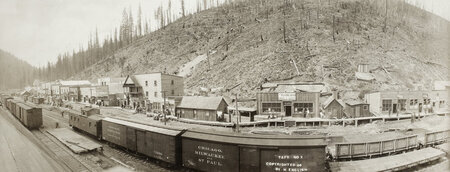
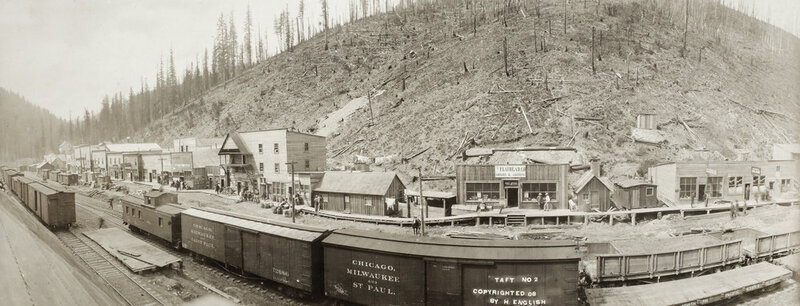
This photo shows the majority of the buildings in Taft including: the post office, a Hotel, Flathead Company, Roma Saloon, Clothing Store, Headquarters Saloon, California Liquor Store, North Pole Saloon, Hay Market Saloon, Meat Market, and several additional saloons to the left. The layout of the town shows how it revolved around the railroad.
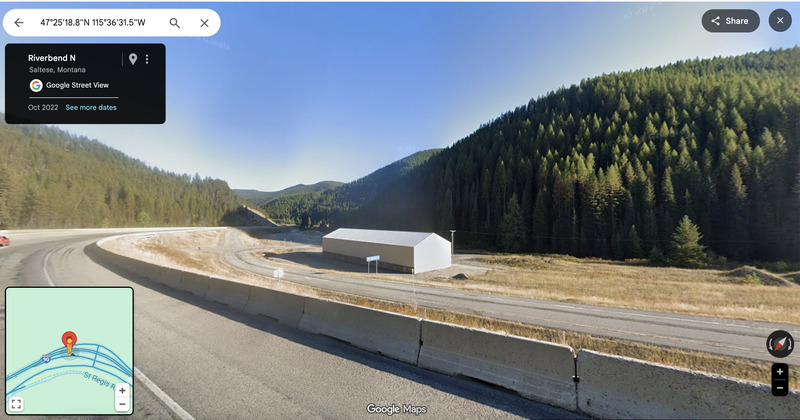
Riverbend N Saltese, Montana
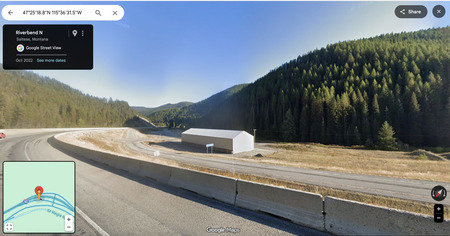
There is some discrepancy between Google Maps and reputable sources as to the location of Taft, which no longer exists. However, the I-90 interstate runs over what should be the historic location of Taft, Montana.
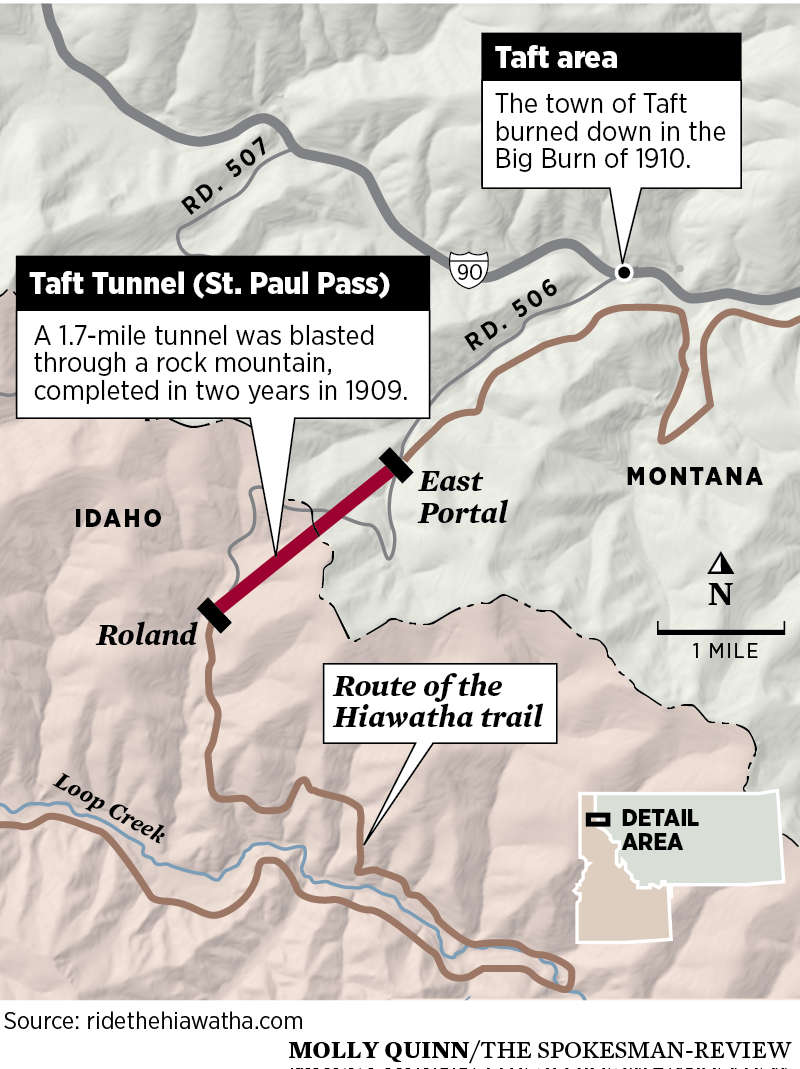
Taft Tunnel Map
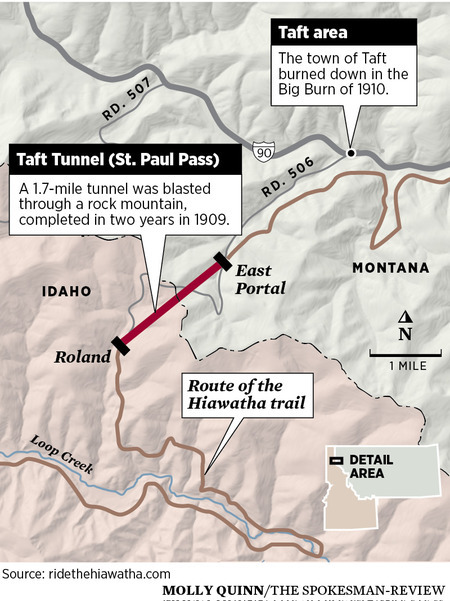
This map shows where the historic location of Taft relative to today's landmarks.
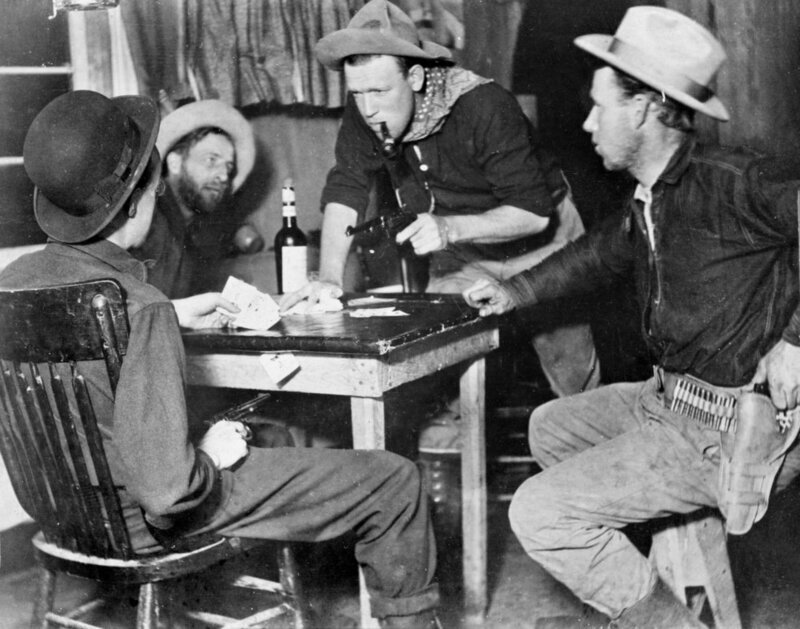
Staged gunfight during a card game
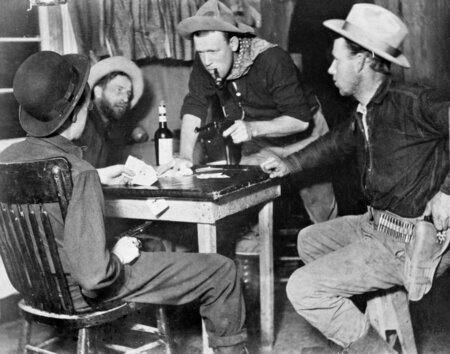
Though it is staged, the photographer captures the spirit of events that were commonplace in Taft. This includes violence and murder born of disagreements from drinking and gambling.