Burke Canyon
The Place
Location: Burke, Idaho
Subjects: burke; mines; railroads; strikes
Time: The late 19th century and early 20th century
Burke Canyon
by Dominic Hutton
Seven miles east of Wallace, Idaho, is a mineral rich canyon, where the ghost town of Burke sits idly. The silver deposits within the canyon attracted railroads to the region as miners started to occupy the area. Burke’s residents endured hardship, from wildfires and avalanches to brutal working conditions. The town’s settlement was followed by a series of natural disasters which devastated Burke’s infrastructure. Retrieving the forgotten history of this town offers a case study of the labor strife and environmental conditions that made the Silver Valley one of the largest producers of precious metals worldwide, while demonstrating the sorts of violence that occurred during the Gilded Age.1
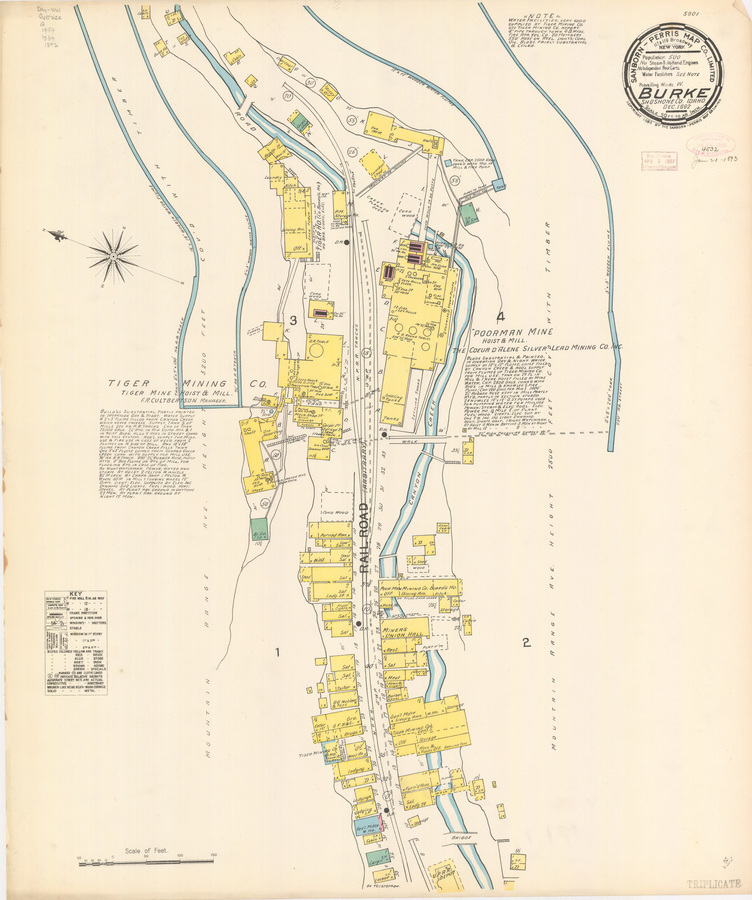
Burke sits at 3,700 feet above sea level at a latitude of 47.5203 degrees north, and a longitude of 115.8192 degrees west. The canyon stretches three hundred feet at its center, hemmed in by steep mountainsides, and the town is longer than it is wide.2 Burke Canyon Creek runs through the canyon floor, which required shop owners to raise their awnings so trains could pass through the town. The narrow canyon is depicted in this Sanborn map of Burke, Shoshone County Idaho, where the railroad ran through the town as buildings sat on each side; many buildings were constructed over Burke Canyon Creek.3
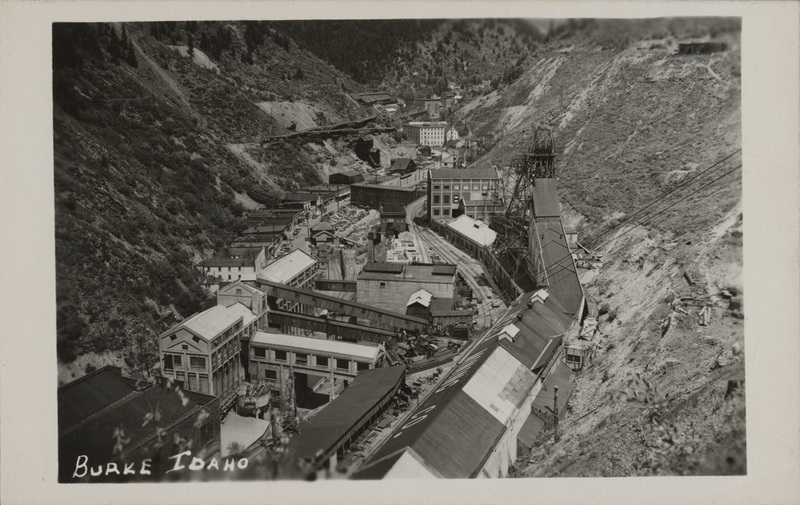
A famous example of infrastructural accommodation is the Tiger Hotel. The Tiger hotel was built in 1887, originally holding 150 rooms and standing three stories tall. The hotel was famous for its unique layout, composed of two distinct sections. The old section of the boarding house was built in 1888, and the large addition was added in 1915. The narrow canyon required the hotel lobby to be split by the railroad. Five passenger trains passed through the building each day.4 This shows the determination of the people who lived in Burke, who found creative solutions to problems caused by limited space on the canyon floor.
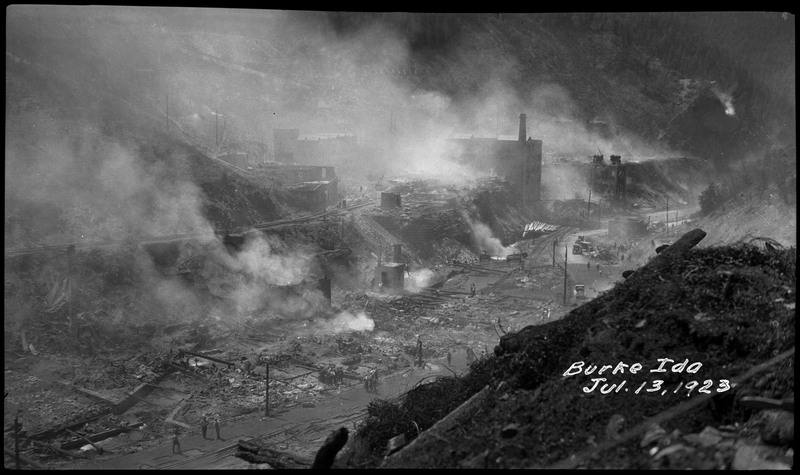
The determination of the residents of Burke to thrive in a small canyon is apparent by the many natural disasters that tore through the holler. The image, Group of people gathered at Hercules Mine after snowslide Burke, Idaho, shows a large crowd of onlookers facing the destruction of a snowslide. The image presents houses smothered in snow and rubble. These were common; Burke’s first recorded avalanche in 1890 killed three people.5 Fires have also devastated the canyon, as shown in the photo Burke, Idaho Fire.6 The image shows the aftermath of the fire that destroyed much of Burke in 1923. The photograph shows smoke filling up the canyon, while debris sits dormant scorched by fire. The fire destroyed fifty businesses and halted important industries in the canyon such as mining when, “Four hundred and forty miners were forced to flee to the depths of the Hecla lead and silver mine.” The mine was closed for five months as the infrastructure was rebuilt.7
Burke is important in the story and legacy of the Coeur D’ Alene Mining Wars. Silver mining in the Coeur d’ Alene mining district had halted by 1892, as many mines were going out of business because the price of lead and silver were declining, and freight costs were rising.8 Owners started offering miners work at a lower pay than was originally granted.9 Tensions in Burke rose in July of 1892, when workers of the Tiger-Poorman mine went on strike against decreased wages and the poor food quality provided by the company.10 Attempting to break up the strike, the owners advertised the strikers’ jobs in Midwestern newspapers. The owners had hired Pinkerton agents as bodyguards for the scab workers coming from the Midwest. The fighting in Burke became so extreme, then Idaho governor Norman Willey would declare martial law. It was in effect for four months, and hundreds of soldiers were sent into the canyon to stop the conflict.11
The labor conflicts surrounding Burke Canyon is important to the legacy of labor violence in northern Idaho. The Coeur d’ Alene mining wars, though not discussed as widely as other labor conflicts like the Battle of Blair Mountain, was significant to the region and the nation. The history of Burke contained a struggle that’s present today with the ongoing class strife within extractive industries. The town of Burke encapsulates the struggles Idaho mining communities faced in the late 19th and early 20th century, ecologically and economically.
Works Cited
-
Collection Builder, Special Collections and Archives. “Narrow Burke, Idaho.” Idaho Harvester. Accessed September 29, 2025. https://harvester.lib.uidaho.edu/posts/2021/12/27/narrow-burke-idaho.html.
-
“Group of people gathered at Hercules Mine after snowslide. Burke, Idaho.”, Idaho Cities and Towns Collection, University of Idaho Library Digital Collections, https://www.lib.uidaho.edu/digital/cities/items/cities748.html
-
“COEUR d’Alene MINING WARS.” Idaho State Historical Society Reference Series 210. Accessed 2025. https://history.idaho.gov/wp-content/uploads/0210.pdf.
-
“THE COEUR D’ALENE MINE LABOR PROBLEM, 1892-1899,” Idaho State Historical Society Reference Series, Accessed November 18, 2025, https://history.idaho.gov/wp-content/uploads/0447.pdf. ↩
-
Thomas, Carolyn, and Steve Mauro, “Burke, Idaho,” Wild West, June 2013, 66+. Gale In Context: U.S. History (accessed September 29, 2025). https://link-gale.com.uidaho.idm.oclc.org/apps/doc/A325893145/UHIC?u=mosc00780&sid=summon&xid=936ad523 ↩
-
“Sanborn Map of Burke, Shoshone County, Idaho, 1909,” Idaho Sanborn Maps, University of Idaho Library Digital Collections, https://www.lib.uidaho.edu/digital/sanborn/items/burke-1909.html ↩
-
“Burke Idaho,” Western Mining History, Accessed September 29, 2025. https://westernmininghistory.com/towns/idaho/burke/. ↩
-
“Burke Idaho,” Western Mining History. ↩
-
“Burke, Idaho fire,” George W. Tabor Photographs, University of Idaho Library Digital Collections, https://www.lib.uidaho.edu/digital/tabor/items/tabor2962.html ↩
-
“Burke Idaho,” Western Mining History. ↩
-
“THE COEUR D’ALENE MINE LABOR PROBLEM, 1892-1899,” Idaho State Historical Society Reference Series, 447 ↩
-
“COEUR d’ ALENE MINING WARS,” Idaho State Historical Society Reference Series, 210 ↩
-
“Burke Idaho,” Western Mining History. ↩
-
Thomas and Mauro, “Burke, Idaho.” ↩
Primary Sources
Burke, Idaho
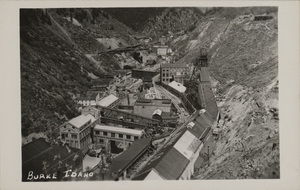
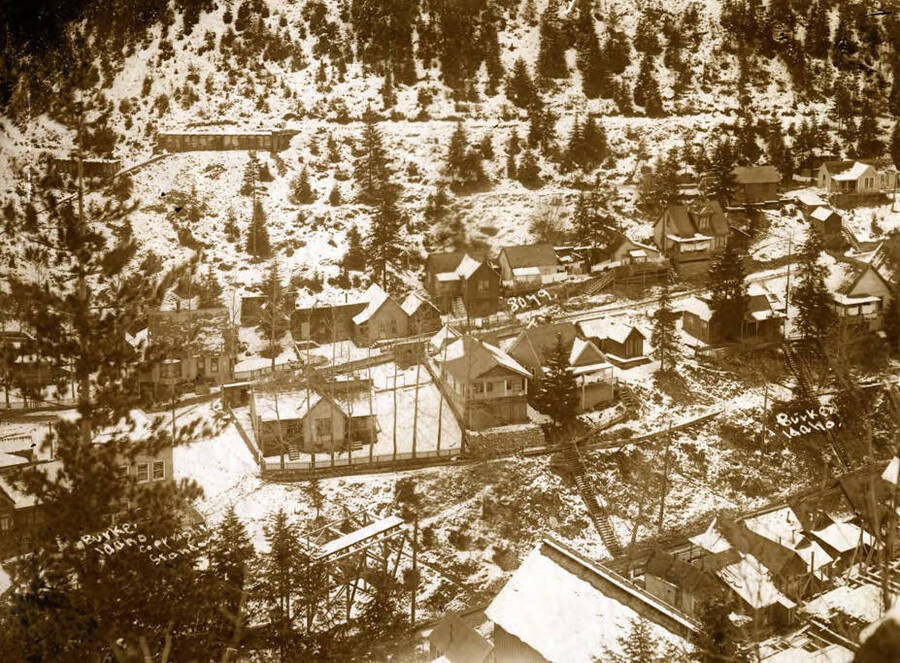
The postcard shows a bird's-eye view of the cramped conditions in the town of Burke, Idaho. Burke is fascinating because the town's settlement was made possible by the ingenuity of the residents, who managed to fit a community into such a narrow canyon. The photograph also reveals the reason for the area's attraction, as ore processing mills were present in the valley.
Burke, Idaho Fire
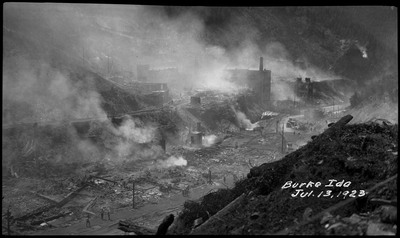
In 1923, the residents of Burke were devastated by a fire that destroyed many of the wooden structures in the valley. The fire demonstrated how vulnerable the town and its citizens were in the tightly packed canyon. Despite the mass destruction, the town rebuilt many of the structures in an attempt to continue their way of life.
Sanborn Map of Burke, Shoshone County, Idaho, 1892
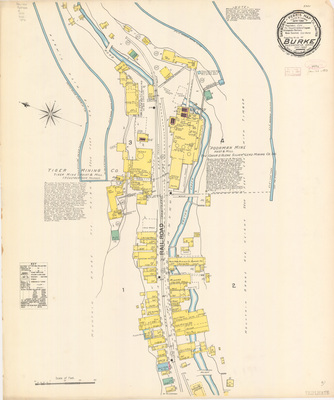
This map was created in 1892, the same year as the first labor incidents in the Coeur d'Alene mining district, an event in which Burke was caught in the middle. The map shows the different mines available for employment in the town for its residents, all of which were affected by the mining strikes in the 1890s. The map also gives a direct look at how cramped Burke was, as the railroad was in the center of the town.
Burke, Idaho
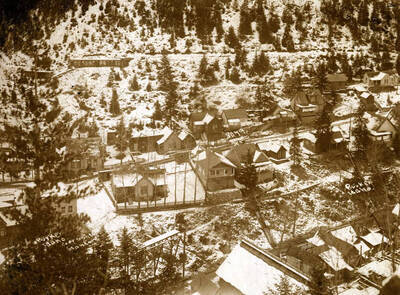
As a site of the Coeur d' Alene mining wars, this photo gives a visual perspective of the residential side of the town of Burke. The canyon was narrow and the main street was occupied by the one train track that ran through the center of the town. The space of Burke was curated for an extractive industry that led the residents to have to compromise comfort for stability by living directly next to the railroad.
Burke, Idaho
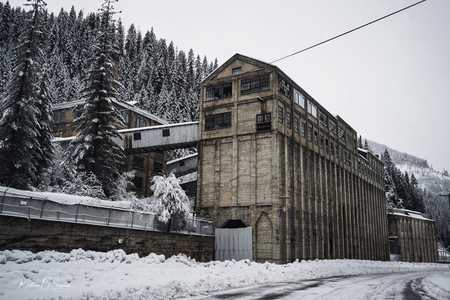
The photo shows a picture of an out of service ore processing plant in Burke during the winter. the concrete building reflects the once productive town of burke, supported by a boom-and-bust industry. burke is a ghost town where the infrastructure tells a story of the northwest as a region that was built on the exploitation of natural resources for short term success.
