Kooskia Internment Camp
The Place
Location: Meeting of Canyon Creek and Lochsa River, Idaho
Subjects: internment; camp; japanese
Time: 1943 - 1945
Kooskia Internment Camp
by James Phelan
The history of Kooskia Internment Camp begins with the Láqsa, the Rough Water. The Lochsa (lock-saw) River slinks through Northern Idaho as part of a tributary chain that runs from the Bitterroot Mountains in Montana to the mouth of the Columbia River in Washington.
Historically, the Nimíipuu people migrated through this landscape to meet the changing of the seasons. Through the ridgelines of the canyon, they crafted trails as land-passageways through country otherwise unnavigable by canoe.1 Their movements would guide the pattern of the roads to come.
Following a treaty negotiation with the United States government in 1855, the Nimíipuu retained 7.5 million acres of their historically occupied land, including the Lochsa River Valley, only for the U.S. to gradually erode the size and sovereignty of their domain through a series of broken treaties and a program of forced allotment.2 In 1908, the U.S. Forest Service created the Clearwater National Forest, an “offspring” of the greater Bitter Root Forest Reserve proclaimed by President Clevland in 1897 in what was once part of the original Nimíipuu reservation.3 Now a National Forest, the land went unworked until the Civilian Conservation Corps (CCC) built a camp in the Clearwater in the summer of 1933 for the purposes of road construction.4 They chose a remote location connected to the waterways; less than a thousand feet from the Lochsa and five and a half miles from where the Lochsa meets the Middle Fork, the CCC workers labored on the “Lolo Trail motorway,” a road based on the Nimíipuu trails. The road would not connect to the future U.S. Highway 12, and the camp survived for only five months.
Canyon Creek Prison Camp opened two years later on the same site for the same purpose of road building. The Lewis-Clark Highway Association lobbied the American government at multiple levels to build a road between Idaho and Montana through the Bitterroots. Imprisoned men at Leavenworth Penitentiary in Kansas volunteered for the heavy-duty labor at Canyon Creek in return for shortened sentences.5 For eight years, these imprisoned men cleared mountains and leveled earth, laying the foundations of a highway. Then, as the American economy shifted to war production leading into the U.S.’s engagement in World War II, the federal prison camp lost funding and closed, only for the Immigration and Naturalization Service (INS) to reopen the site in 1943 in its final form: Kooskia Internment Camp.6
INS operated the internment camp at Kooskia to finish construction of Highway 12, a “First Priority Military Highway” needed for strategic operations.7 The penal arm of the American government exploited labor through “the imprisonment of individuals who are not naturalized American citizens and whose country of origin is in conflict with the United States of America.”8 The 260 men interned at Kooskia between 1943 and 1945 were Issei and Nisei, first and second generation non-naturalized Japanese Americans, and they too volunteered for heavy labor at the remote Kooskia site, opting to leave other internment camps in New Mexico and California in exchange for a small salary. Their fabrication of America’s priority highway earned them $50 - $60 a month.9 They worked parallel to the Lochsa, slithering the highway along the river’s run from Lolo down to Kooskia.
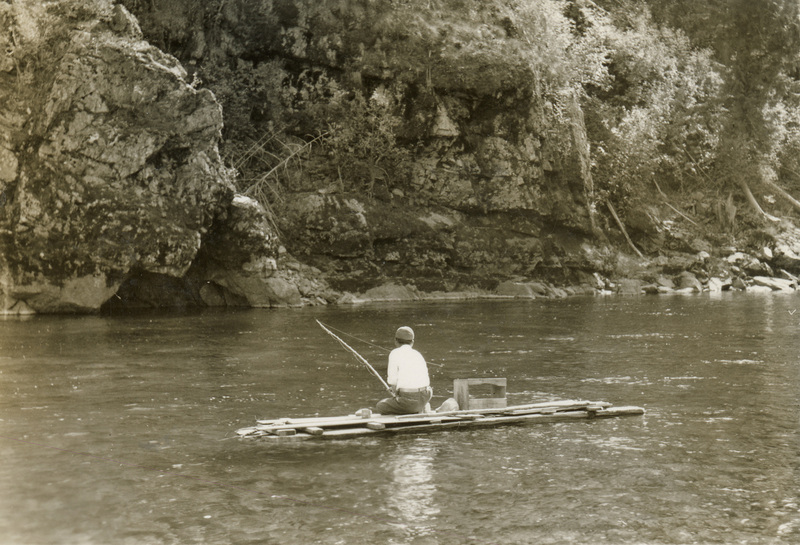
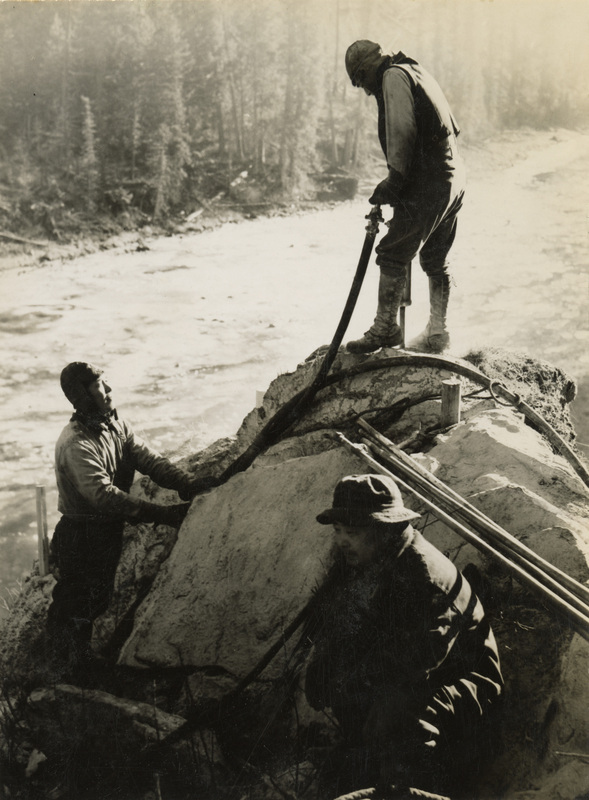
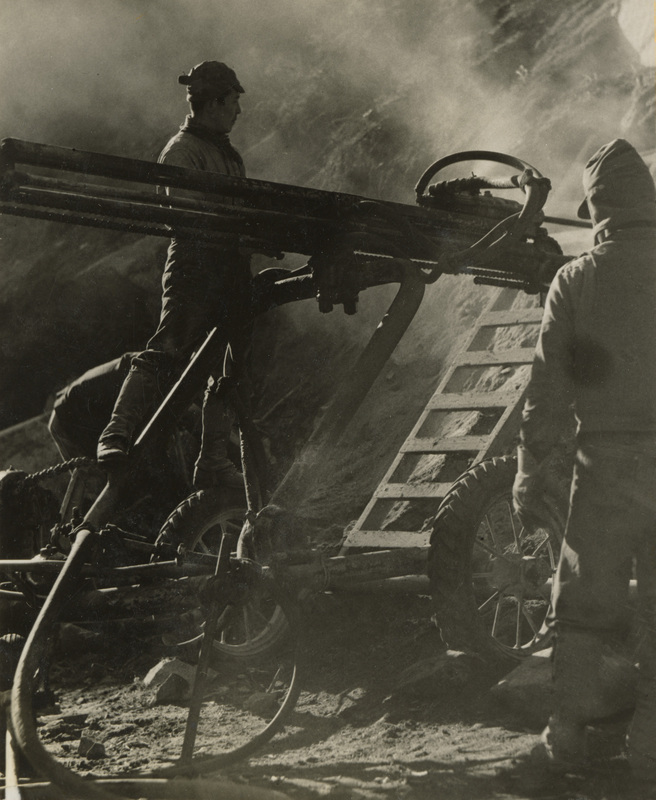
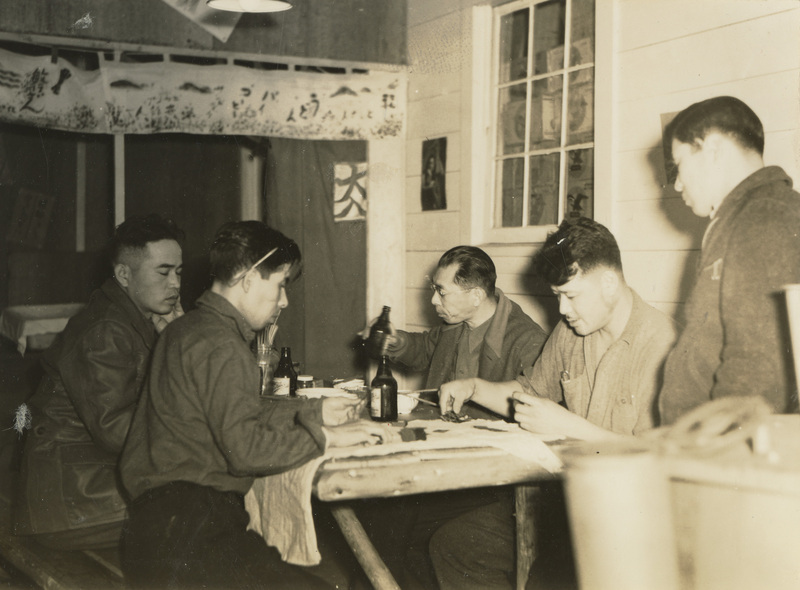
Because of the “voluntary” nature of Kooskia, the camp functioned as a tool of racially motivated imprisonment and a not-uncommon arrangement for remote laborers in the rural northwest throughout the first half of the 20th century. Though the men were interned and compelled to work at length, they were otherwise free to fish, cook, drink, and socialize together.10 Photos from the camp highlight the juxtaposition. A photograph series taken in 1944 portrays the Issei and Nisei men as convivial, relaxed, and industrious. Physical evidence from the camp–both photographic and archeological–presents a distinct lack of carceral imagery. These men were at liberty but not free, and their work was far from easy. They constructed Highway 12 by shoveling, picking, hammering, and blasting their way through the Lochsa River Valley.11
The camp at Kooskia closed in May of 1945 before the end of the war as the internee population waned.12 The buildings were slowly dismantled, and the site, other than the concrete slab of the handball court, returned to the forest. Kooskia internment camp exists no longer, though U.S. Highway 12 remains, winding next to the Lochsa en route to the Bitterroots.
Works Cited
-
Priscilla Wegars and Mitziko M. Ayukawa, Imprisoned in Paradise: Japanese Internee Road Workers at the World War II Kooskia Internment Camp (Moscow: Asian American Comparative Collection, University of Idaho, 2010), xxi. ↩
-
Nez Perce Tribe, “History | Nez Perce Tribe,” accessed November 7, 2025, https://nezperce.org/about/history/. ↩
-
R. S. Space, The Clearwater Story: A History of the Clearwater National Forest (Forest Service, USDA, 1980), 48. ↩
-
Wegars and Ayukawa, Imprisoned in Paradise, xx. ↩
-
Wegars and Ayukawa, Imprisoned in Paradise, xxi. ↩
-
Wegars and Ayukawa, Imprisoned in Paradise, xix. ↩
-
Wegars and Ayukawa, Imprisoned in Paradise, 124. ↩
-
S. L. Camp, “Landscapes of Japanese American Internment,” Historical Archaeology 50, no. 1 (2016): 170. ↩
-
Wegars and Ayukawa, Imprisoned in Paradise, xxi. ↩
-
Wegars and Ayukawa, Imprisoned in Paradise, 97 – 124. ↩
-
Wegars and Ayukawa, Imprisoned in Paradise, 50 – 80. ↩
-
Wegars and Ayukawa, Imprisoned in Paradise, 181. ↩
Primary Sources
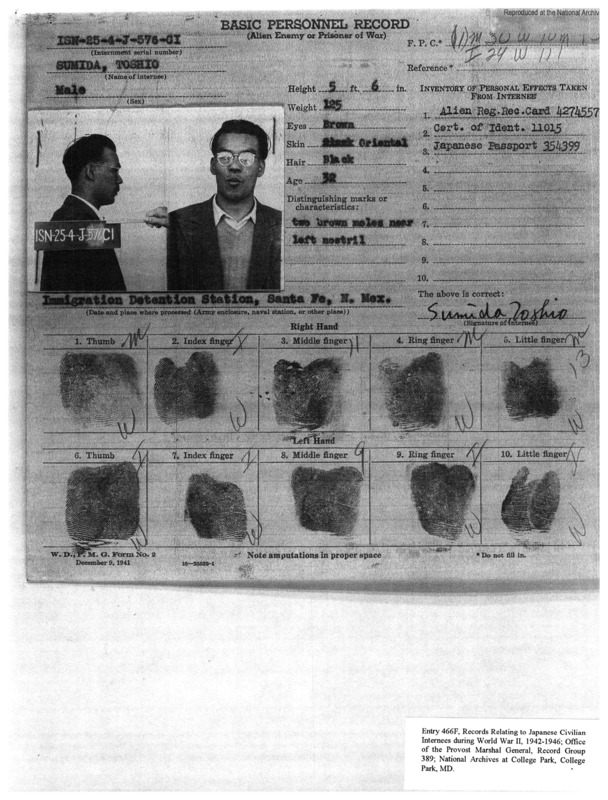
Basic Personnel Record for Toshio Sumida
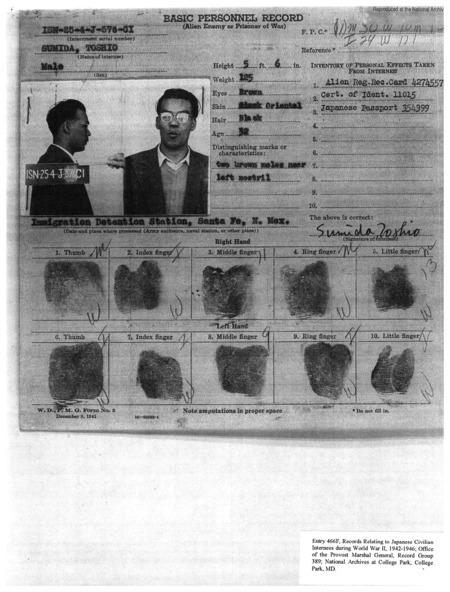
Toshio Sumida was born in Japan on 1909-09-23. Sumida was detained on 1942-03-13 in Los Angeles, California and taken to the Kooskia Internment Camp in Kooskia, ID on 1943-09-20. This Basic Personnel Record catalogues Sumida's physical characteristics, inventories his taken personal effects, catalogues his education, and documents other details of his capture and incarceration.
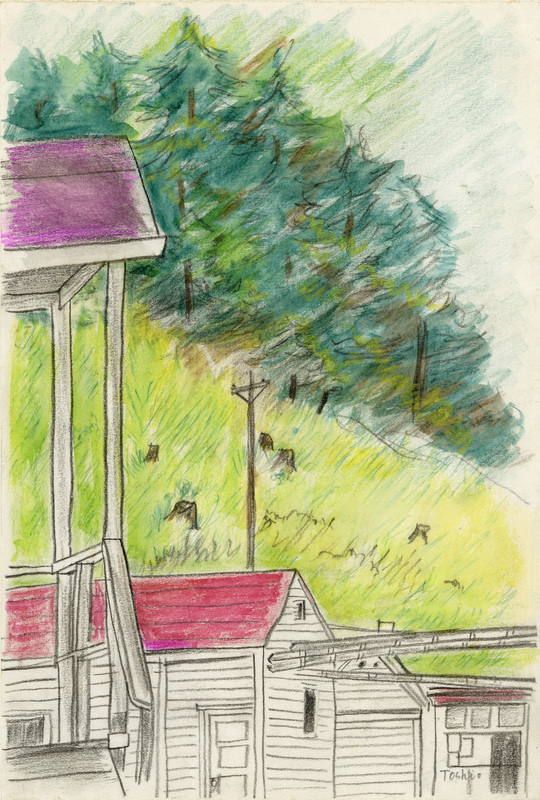
Hand drawn picture of Kooskia scene
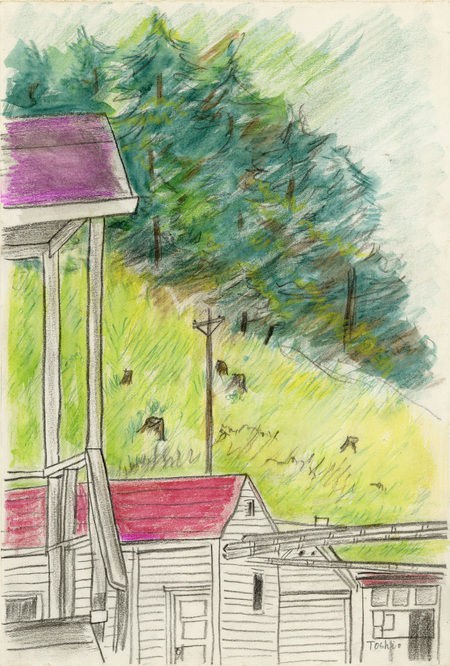
This drawing is one of two found in the Kooskia Internment Camp Scrapbook drawn by Toshio Sumida, a detainee at the camp from 1943-1945. Toshio's drawing reflects the wild beauty of the camp juxtaposed against the carceral camp buildings at the site.
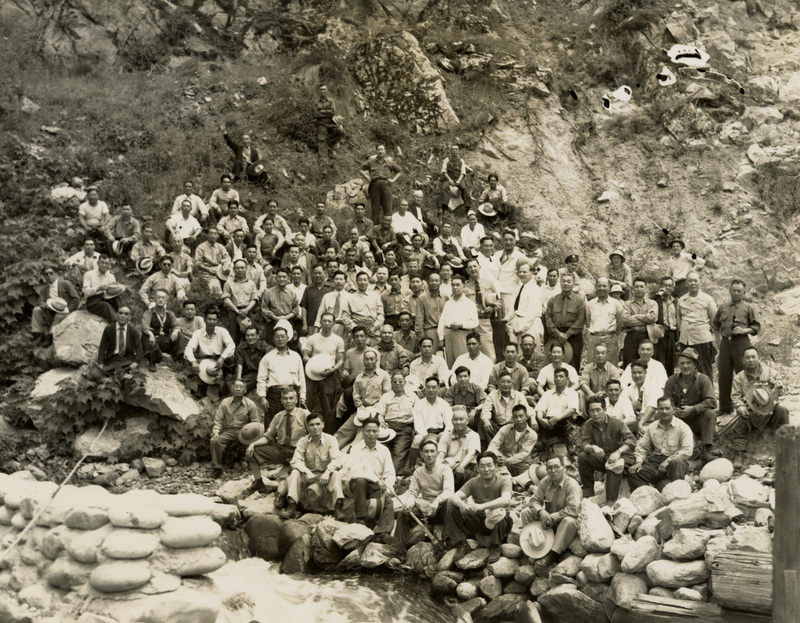
Group photograph of men at work site
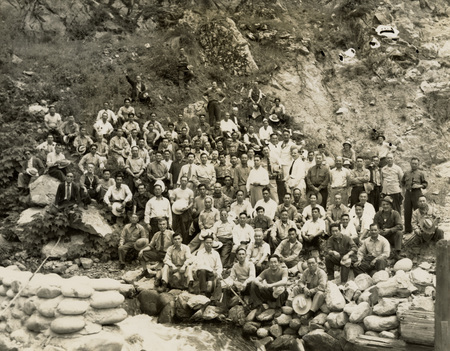
Depictions of daily life and labor at Kooskia Internment Camp present the multifaceted experience of the internees. The men worked laborious, often technical jobs as they cleared the terrain and constructed Highway 12. The images also present the active social lives of the men as they entertained themselves in the remote Idaho backcountry.
Construction work by Lochsa River near Kooskia
Depictions of daily life and labor at Kooskia Internment Camp present the multifaceted experience of the internees. The men worked laborious, often technical jobs as they cleared the terrain and constructed Highway 12. The images also present the active social lives of the men as they entertained themselves in the remote Idaho backcountry.
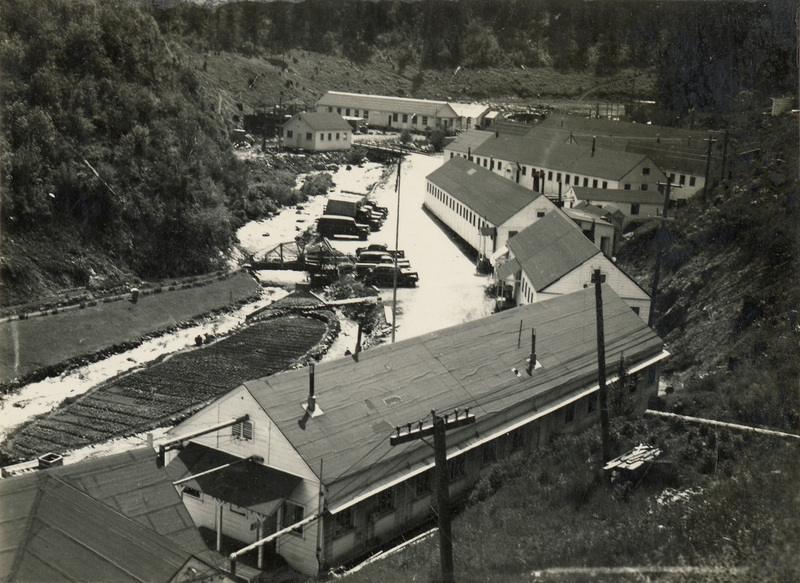
Buildings at Kooskia showing Canyon Creek and road
Depictions of daily life and labor at Kooskia Internment Camp present the multifaceted experience of the internees. The men worked laborious, often technical jobs as they cleared the terrain and constructed Highway 12. The images also present the active social lives of the men as they entertained themselves in the remote Idaho backcountry.
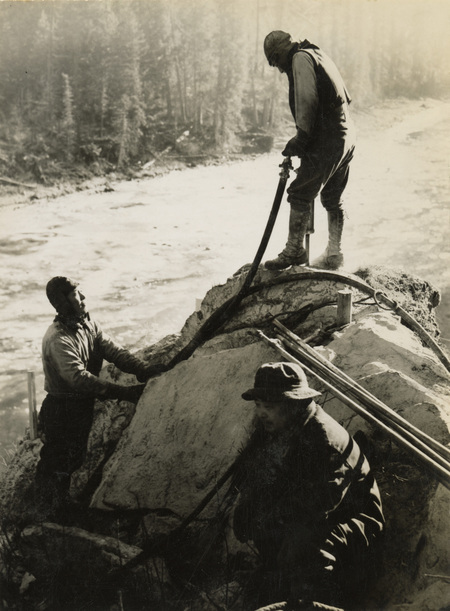
Construction work near Kooskia with men drilling into cliff face
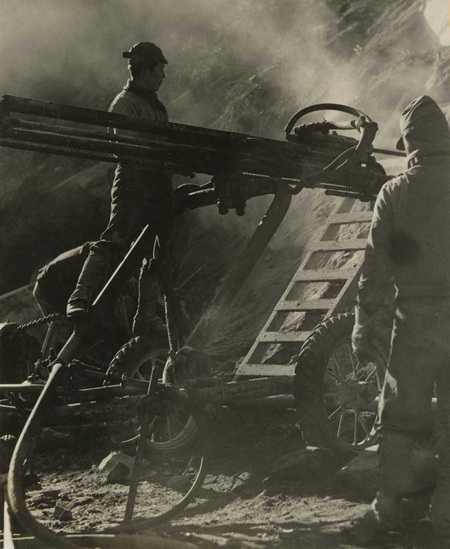
Depictions of daily life and labor at Kooskia Internment Camp present the multifaceted experience of the internees. The men worked laborious, often technical jobs as they cleared the terrain and constructed Highway 12. The images also present the active social lives of the men as they entertained themselves in the remote Idaho backcountry.
Men playing card game in Kooskia
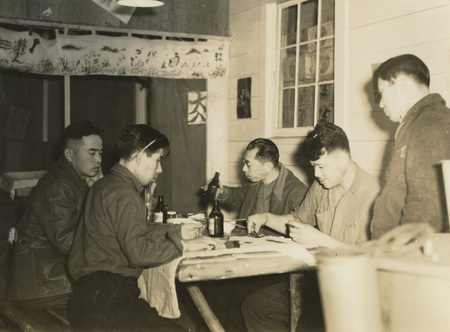
Depictions of daily life and labor at Kooskia Internment Camp present the multifaceted experience of the internees. The men worked laborious, often technical jobs as they cleared the terrain and constructed Highway 12. The images also present the active social lives of the men as they entertained themselves in the remote Idaho backcountry.
Fishing on raft near Kooskia
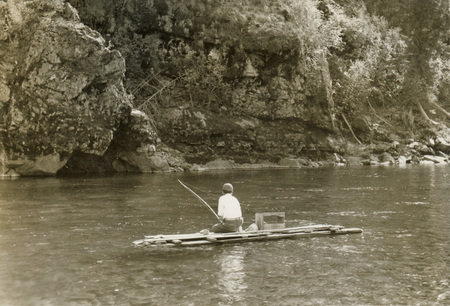
Depictions of daily life and labor at Kooskia Internment Camp present the multifaceted experience of the internees. The men worked laborious, often technical jobs as they cleared the terrain and constructed Highway 12. The images also present the active social lives of the men as they entertained themselves in the remote Idaho backcountry.