The Spokane Downtown Urban Renewal plot
The Place
Location: Spokane, Washington
Subjects: urban; urban renewal; cities; property
Time: 1959 - 1975
The Spokane Downtown Urban Renewal Plot
by Logan Romans
In Spokane Washington, history is both old and new. The city is named after the Spokane people who lived and traded at the foot of the falls for thousands of years, and who continue to access ancestral lands despite being forcibly removed. The white history of Spokane, however, is young and only gets younger with the city built and rebuilt throughout its life. First, the fire in 1889 that served to destroy almost the entire Spokane downtown only for it to be bought up and redeveloped almost immediately preceding the economic depression of the 1890s. This trend continued with Post World War Urban Renewal as part of the World Expo that created a vibrant river which runs through the heart of the city.
Downtown Spokane is a collection of historical buildings, convention centers, clothing stores, and parking lots, known today as the premier destination for live music in the interior northwest. The city’s downtown makeup is not an organic one instead from a masterplan created for the 1974 World Expo. Expo ‘74: which was the first environmentally themed world fair in the 20th century. The expo was the brainchild of King Cole; a renowned renewal specialist focused on reclaiming the Spokane river and falls from the industrial age. The expo didn’t come easy but rather resulted from the hard work of the new city manager system in Spokane, conveniently started and controlled by some of Spokane’s wealthiest downtown landowners.
This story starts in post-war Spokane, a time when many American cities saw an exodus of people and business from urban centers to the suburbs. This exodus caused the business owners of Spokane to panic. Originally Joe Kipper the manager of Sears and Robuck and future chairman of the Spokane Public Urban Renewal Service partnered with John Heiber a “property manager with extensive interests in downtown real estate.”1 This partnership would include several other prominent figures such as banker and future mayor Neal Fossen who came together and formed a plan to revitalize downtown and hopefully their investments.2 In their salvation lied urban renewal, which has come to refer to a popular program implemented across the country in which areas of cities—often residences for marginalized populations—were bulldozed for automobile infrastructure and new modernist developments. Using urban renewal, Spokane sought to demolish all ‘substandard housing’ and fund ‘rehabilitation’ which usually meant opening the new land to market forces. When they presented their plan to the city commission, they were emphatically rejected. These owners, known as Spokane Unlimited, formed what came to be called the Committee for Good Government and instead of accepting defeat, came up with a different plan.
The Committee rallied hard for the commission style government to be dissolved and a ‘city manager’ government instead. With the help of a staunch ally William Cowles the owner of the newspaper the Spokesman Review they were able to garner enough support for the movement. Upon the formation of the new government, a new election was scheduled for later in the year. The business interests created their ‘dream team’ Fossen and the Citizen Six “While most candidates raised and spent a few hundred dollars, the “Citizen Six” pooled their money and bought more than 50 billboards, tens of thousands of brochures and dozens of newspaper ads.”3 Ultimately, the election gave the mayor and 4/6 council seats to Fossen and his crew. The former members of Spokane Unlimited immediately went to work and pushed a renewal proposal to the tune of $10,407,000\ (~$109,000,000 adjusted for inflation). Many of the major proponents of the measure such as Spokane Unlimited and the city council failed to mention the estimated $11,000,000\ (~118,000,000$ adjusted) increase in downtown property value as a result.4
In an ironic twist despite heavy lobbying for the 10.5 million bond, it failed by a landslide, securing just 40% of the necessary 60% of the vote.5 The city council in a stroke of genius decided to push the bond again the next year and shockingly failed again. Thus, the efforts of Urban renewal by Spokane Unlimited had completely failed. Or at least until John Heiber would meet an eccentric Urban Planner named King Cole. King would then throughout the 1960s and early 1970s, utilize grass roots support and a considerable amount of help from the chair of the Washington Trust bank, cofounder of the Pack River lumber company, and the grandson of a Fidelity founder to eventually achieve Cole’s evolving riverfront dream.6
The semi failed cooptation of Spokane is somewhat anomalous throughout the region. Despite some setbacks regardless of corporate interests and organization in Spokane ultimately struck back against its takeover. While it had some urban renewal efforts in the Freeway construction project, the aims of Spokane Unlimited were eventually hijacked by King Cole and his more balanced urban world view and weren’t fully realized.
Works Cited
-
William T. Young, The Fair and the Falls: Spokane’s Expo ’74 : Transforming an American Environment, Eastern Washington University Press, 1996 ↩
-
Young, The Fair and the Falls ↩
-
Stimson, William. “The Big Quake of 1960.” The Inlander, September 3, 2003. https://www.inlander.com/news/the-big-quake-of-1960/article_cad7d066-0742-5e6a-8aa2-180a163a8e9d.html ↩
-
Young, The Fair and the Falls ↩
-
Young, The Fair and the Falls ↩
-
Young, The Fair and the Falls ↩
Primary Sources
General Housing Conditions in Spokane
This report references some of the most iconic projects that exist in Spokane today, such as the construction of Interstate 90 through southern Spokane. It also has significance to my own project because it was sent to the newly formed government that was specifically formed to pass urban renewal plans. The report includes the programs that were going to be used to enact these changes, imploring the use of a federal funding scheme.
Analysis of the Spokane, Washington Housing Market as of December 1, 1966
A FHA report detailing the local housing market for use in mortgage insurance operations
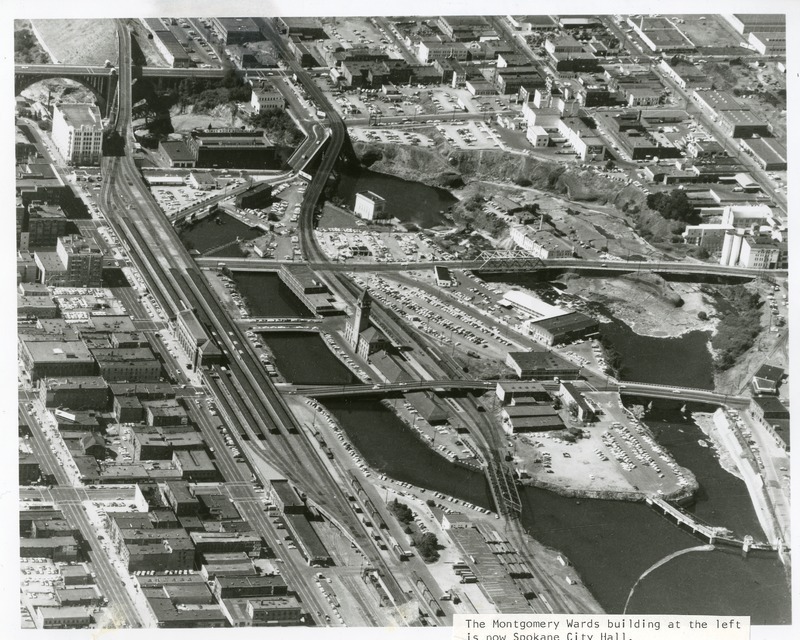
Spokane -- Expo '74 -- Views Before (#04)
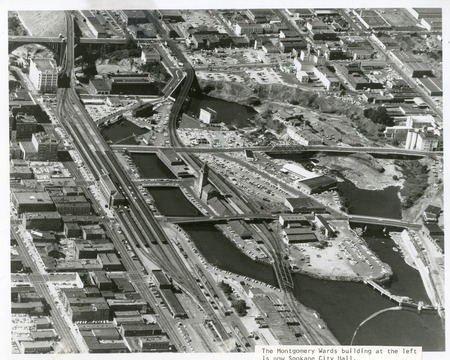
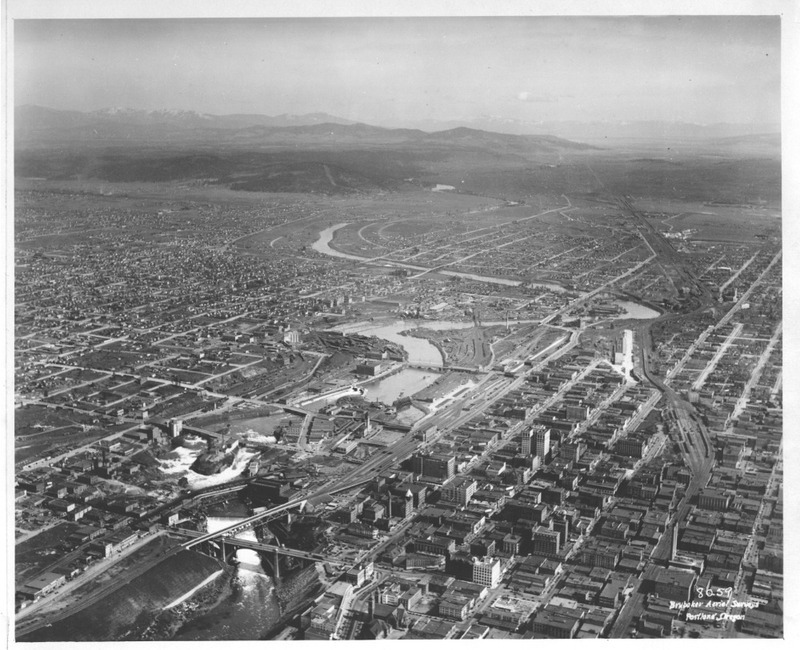
This picture is a moment lost to history, Spokane's riverfront, which for most alive today is redeveloped. This shows downtown industrial and apartment buildings, many of which were destroyed and turned into convention centers or parking lots. This picture is exactly one year after the new Spokane government took over, with the 'new' Spokane city hall in view before it was the city hall.
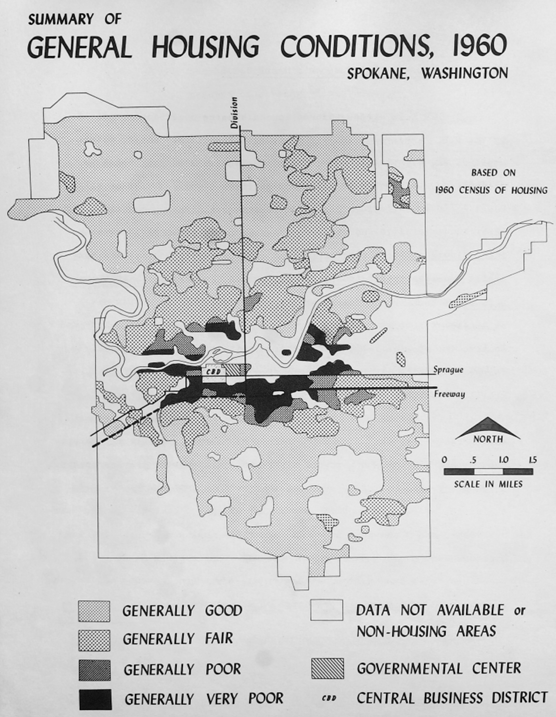
Summary of Genreal Housing Conditions in Spokane
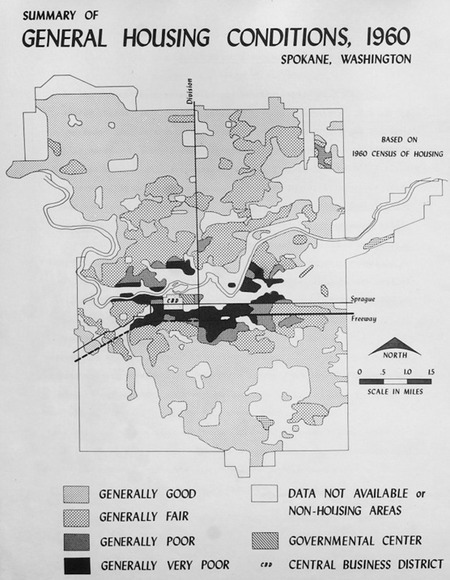
This map shows the specific areas that the Urban Renewal Department wants reformed. It shows the scale of the Urban Renewal that would be pushed. It also shows the future freeway that would be built through poor-quality housing areas.
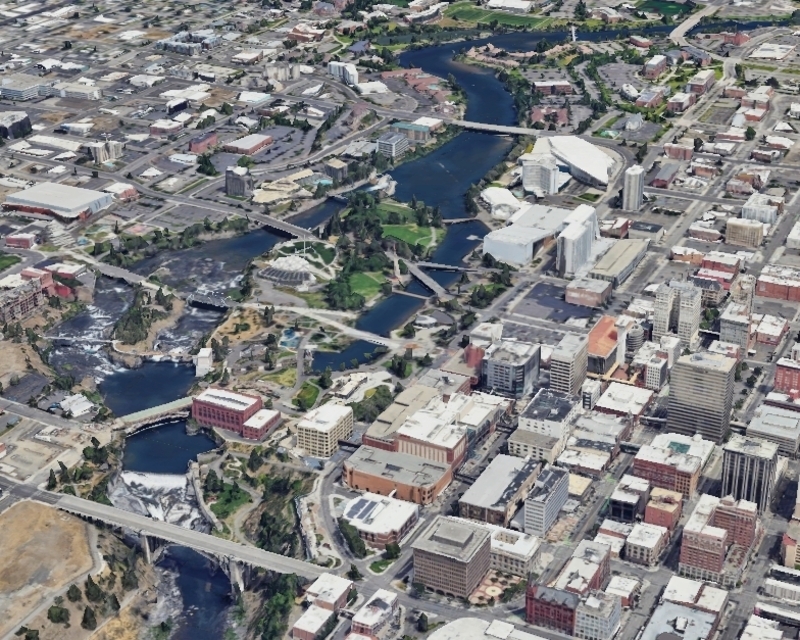
Contemporary Spokane Image Google Earth
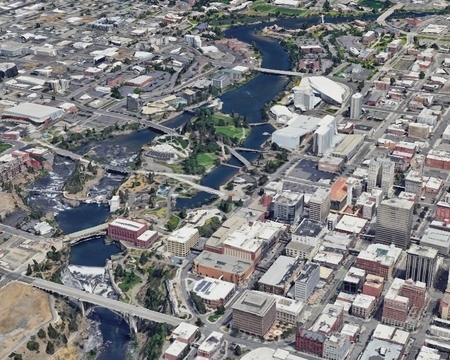
This image shows the new riverfront, coated in convention centers and greenery.
Spokane Downtown Pic 1959
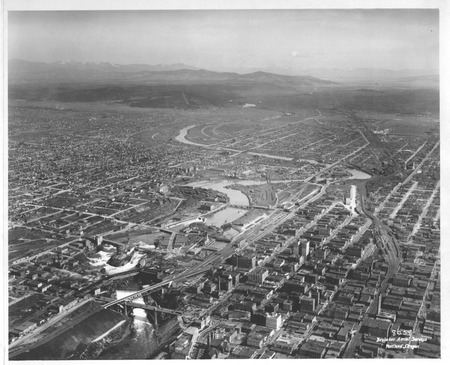
This photo shows Spokane before its radical transformation in 1974. This picture is important because it shows the true look of Spokane during the urban renewal debate.