Felix
The Character
Our essay covers the struggles of a house slave during the 2nd century in ancient Rome. We cover the emotional aspects of such a task back then.
Name: Felix
Gender: Male
Age: 14
Status: Slave
Family: Master is Felix's biological father, mother is a slave
Occupation: Slave
Time Period: Second Century CE
Location: Rome, Italy
Slavery in Ancient Rome
by Spencer Hegstad, Jack Droesch
Born of an enslaved mother and elite father, Felix’s life in ancient Rome was set up to fail. Like many slaves born into slavery in Rome, Felix’s father was also his master. Day in and day out, Felix would have been tasked with completing menial chores forced upon him by his master.
Rome: A Slave Economy
The largest piece of the puzzle that kept Rome afloat was slavery. Slavery infiltrated almost every aspect of life in the ancient world, from economic production to household organization and social identity. Enslaved people were present in vast numbers across the empire and performed a wide range of roles, including agricultural labor, skilled craftsmanship, and domestic service in homes. Sandra Joshel has written extensively on Roman slavery. In one book, Slavery in the Roman World, Joshel provides a table that gives great insight into the roles of slaves in the Roman Empire. The table shows around twenty distinct slave occupations ranging from teachers to architects to bath attendants to bodyguards.1 Enslaved people in Rome did not occupy a single role but instead performed a wide range of tasks that could shift depending on the needs of the household. This backs up the claim that slavery was an incredibly vast system that was present in almost every aspect of society.
Another important piece of background knowledge on slavery in the Roman Empire is the ways in which slaves were viewed and treated. Like most common types of slavery, enslaved individuals were legally considered property rather than persons. Slaves were often given collars that freed people could use to identify where to return them to if they escaped or were lost, thus treating them like dogs.
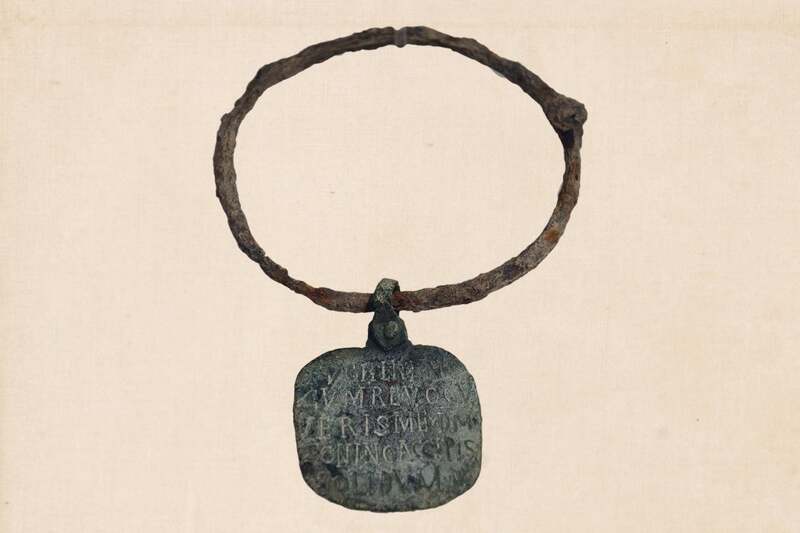
They were subject to the authority of their masters and vulnerable to punishment, control, and exploitation. Joshel goes into detail to back up this claim. She argues that slaves were referred to as tools. Slaves were subject to punishment by means of burning, crucifixion, beatings, even being thrown to wild animals. Punishment led to death in many cases.1 Even though they had this lack of autonomy, they existed at the center of Roman life.
A Household Servant
An elite Roman household depended on enslaved labor, and those who organized and carried out that labor held a complex position in the family and society. There were elite male heads of households who exercised legal authority over their families but also over people who were considered property. The people enslaved to these elite men that were responsible for the daily domestic and sometimes supervisory tasks. Many slaves like Felix existed, slaves who were tasked with everyday household chores as well as duties that took them outside the home, like escorting his master’s children.
This role would typically have been associated with a pedagogus, an enslaved attendant responsible for escorting a child to school and supervising his behavior. However, Felix’s situation complicates this definition. Felix is only twelve years old, so he would have not formally been considered a pedagogus. This does not mean that he was excluded from performing similar duties. Roman slavery was structured around status rather than strict occupations. Sandra Joshel talks about how enslaved individuals could be assigned to a wide range of duties depending on the household’s needs (Joshel, Slavery in the Roman World). We used this to justify Felix having pedagogus-like tasks. His role also highlights how slavery in ancient Rome would blur work categories while still having that control on social boundaries.
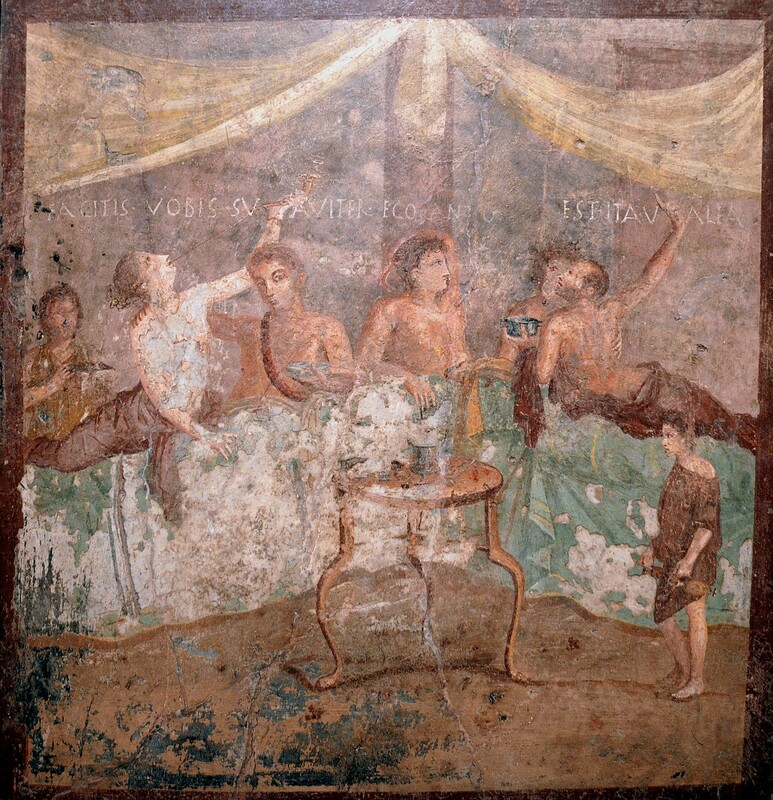
This fresco is a great example of how hierarchy was structured in Felix’s world. The figures at the center of the image are positioned as elites in a banquet. The elites are elevated on top of a structure and are literally larger in scale. They all have relaxed posture, in a way signaling their status, wealth, and most importantly their social dominance. Below the elites is the enslaved figure, who is stiff, controlled, and focused. He holds a pitcher, indicating his role as a servant. We think that making him smaller in size was intentional to signal his slave status.
The fresco does give us limits to what we can know. We cannot identify the maker of this fresco or specific conditions of the enslaved person’s life, but it does not prevent our analysis. We can see how Felix would have been perceived visually back in ancient Rome. We could easily place Felix in the role of this household slave as he could have had similar tasks during social events like this. Like the figure in the fresco, Felix’s whole visual identity would be shown by his work.
Control of the Mind and Body
The household in Ancient Rome was defined by a constant awareness of power. And this hierarchy was visible in every interaction and enforced through discipline and through daily routines that reminded enslaved people of their position. In Seneca’s letter 47, we can understand this relationship. Seneca describes how control was maintained through constant surveillance and punishment: “The slightest murmur is repressed by the rod; even a chance sound- a cough, a sneeze, or a hiccup- is visited with the lash.” He also talks about how enslaved people were expected to remain physically and socially beneath their masters: “when we recline at a banquet one slave mops up disgorged food, another crouches beneath the table and gathers up the left-overs of the tipsy guests.2
For Felix, it would be hard to say that this structure of slavery would not have shaped his internal world, It would be plausible that he moved throughout his day with a heightened awareness of potential punishments. Subconsciously he would be asking himself after his every move if his behavior would warrant punishment. This self-regulation is something that was brought up in the writing of Epictetus, who says that a master, “has power over your body,” not just physically but mentally. Resentment is also something to consider. Seneca writes, “they are not enemies when we acquire them; we make them enemies.” We think it is plausible that Felix would have known that his master was his biological father, and seeing his half-siblings move freely through the household would plausibly cause tension.
And maybe resentment would not be the only emotion at play. Within a household defined by dependency and proximity, it is also plausible that Felix desired approval or recognition from his father. As interesting as it would be to contemplate, this, the sources do not allow us to determine a slave’s emotions. Most sources talking about slaves are written by elite men like Seneca, who describe slavery but doesn’t provide the perspectives of the enslaved. Critical fabulation, a research method that combines historical evidence and ethical storytelling, works within this gap, so in Felix’s case, the evidence suggests his life would have been shaped by discipline and emotional complexity.
Roman Afterlives
The system that made Felix’s life the way it was did not go away as the Roman Empire fell. Roman customs of household hierarchy, inequality, and slavery had an impact on later societies throughout the world and especially in America. Modern depictions of Rome, particularly in films such as Gladiator, highlight spectacle, military might, and elite masculinity, while downplaying the realities of the enslaved labor that made those lifestyles possible.
Felix’s reality goes to show that Rome being idealized as a “great” civilization overlooks the role that slavery played in its system. Our interpretation reexamines Roman society by focusing on a child who is biologically linked to power but cannot access it and looks at Roman society as one built not only on achievement, but on exploitation that was embedded and socially reinforced. Felix is both biologically tied to power and denied access to it.
Sources Cited
- Epictetus. Discourses. Translated by Robin Hard. Oxford: Oxford University Press, 2014.
- Stanford University. ORBIS: The Stanford Geospatial Network Model of the Roman World. Accessed April 22, 2026. https://orbis.stanford.edu
- “Roman Fresco of a Banquet Scene, Pompeii.” Archaeological remains from Pompeii, 1st century CE.
- Bradley, Keith. Slavery and Society at Rome. Cambridge: Cambridge University Press, 1994.
- Joshel, Sandra R. Slavery in the Roman World. Cambridge: Cambridge University Press, 2010.
- Jasiński, J. (2020, May 6). Roman slave collar “ imperium romanum. Imperium Romanum. https://imperiumromanum.pl/en/curiosities/roman-slave-collar/amp/#google_vignette