Valeria Secunda
The Character
Valeria Secunda is of a baker's family. She lives in Massilia, France with her husband and one infant. They run a bakery and their lives are based on the schedule of baking bread.
Name: Valeria Secunda
Gender: Female
Age: 26
Status: Citizen
Family: Married with one infant child
Occupation: Artisan
Time Period: First Century CE
Location: Massilia, Gaul
Valeria Secunda
by Aleah Skidmore
Valeria Secunda- twenty-six years old. Mother to one infant child. She lives her life baking bread and working for the family bakery.
Character Narrative
This is a narrative of a fictional character, Valeria Secunda, serving as a tool to convey a composition of actual evidence of daily life in Ancient Rome. Valeria Secunda was a young woman in the early first century, around the year 25 CE. Valeria was a citizen of the Roman Empire but lived on the outskirts in Massilia, France. Massilia was an opulent port town that had been fully integrated into Rome only fifty years earlier, after choosing the wrong side in the civil war and being punished by Julius Caesar (Wasson). At the time Valeria lived, Massilia would have been comfortably accustomed to Roman ways. Her location in a port town would have been beneficial to the family business she ran with her husband. Together they ran a bakery, one that would have presumably provided a comfortable income for themselves and their family. Throughout this narrative depicting the daily life of Ancient Rome, her life will show the challenges of being both a working woman and the mother to a young infant during a period of different social standards and expectations.
Although Valeria lived outside of Italy, her home of Massilia was still a grand town with a large population. In an article on the history of Massilia, the port town was described as opulent and very important to the trade of the empire. This epicenter of trade, although recently Roman, would have been a valuable resource to its neighboring towns. Valeria’s daily life would have been different were she to live somewhere without the resources from the port. This port would have provided the necessary means for running a successful business, her bakery included.
Bread was a central element of the Roman diet, and it played a role in the daily life of all Roman subjects as “Bread was a staple of the ancient Mediterranean diet” (Benton). There was also a cultural element to bread as “it was present in the meals of emperors and on the tables of the poorest households” (Benton). Everyone ate bread, and many people purchased their bread from bakeries. Many Roman homes did not have individual ovens during this time, so bakeries would have been responsible for a large amount of production to supply for the people of their towns (Benton). Bread was a commercially made good, and the supplies would have been highly costly. Because bread was so important, and people of all ages and classes consumed it, the work and time put into production would have been a large part of the lives of Valeria’s family. There were people, and even animals, in charge of every step of the bread making process who would have been putting their entire days into the making of bread. Bakeries of this time were very large to accommodate for the sheer amount of power that goes into making enough bread to supply everyone. They had giant ovens; one found in Pompeii was large enough to bake eighty loaves of bread at one time (Wilkins). They have large mills that were powered by donkeys, so the room for them was immense. Bakeries were large, bustling, and unbearably hot from the ovens.
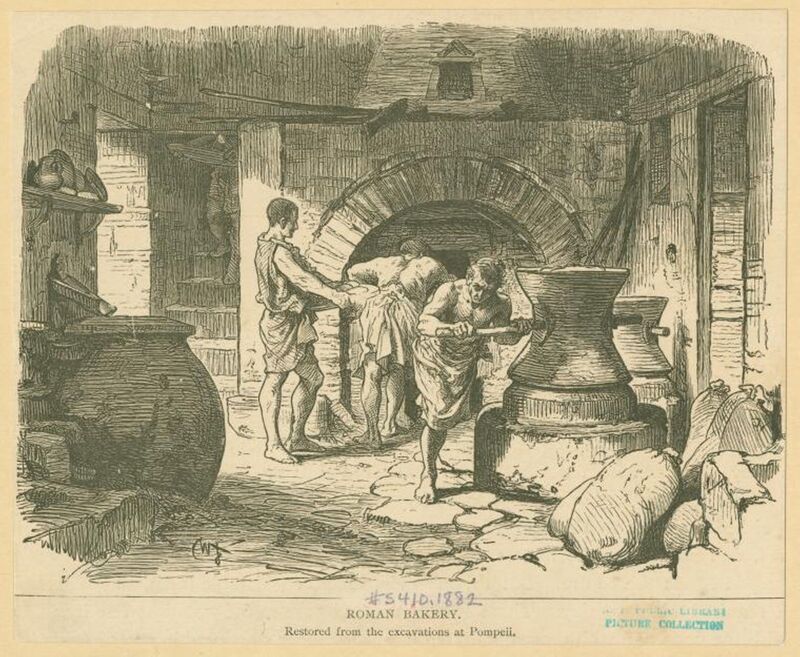
This image, a relatively modern drawing of how an ancient bakery would have functioned, reveals several aspects of daily life and labor in the Roman world. Bread was a staple food in Roman cities, and bakeries were essential parts of urban neighborhoods. The presence of large mills and ovens suggests that bakeries were not just small kitchens but organized production spaces where grain was processed, dough was prepared, and bread was baked in significant quantities. The workers shown in the image appear to be performing physically demanding labor. Grinding grain, kneading dough, and operating ovens required strength and long hours of work. In many Roman bakeries, much of this labor was carried out by enslaved people or low status workers. The image therefore reflects the reliance of Roman urban life on manual labor and the social hierarchy that structured work in cities. The bakery also demonstrates how food production was integrated into everyday urban spaces. Bakeries were often located along streets where bread could be sold directly to residents. This suggests frequent interaction between workers and customers and shows how essential food production was to the functioning of Roman communities.
Valeria’s role as the matriarch of the family would have been crucial to the function of the bakery. She would have been responsible for keeping the books of the bakery and assisting her husband with the production of the bread, all while raising a young infant. Her life would have been on a timer, controlled by the baking of bread, delivery of goods, and the sale of their product. It was traditional that women would have been educated to the extent that they could keep the books for their families, but not outsmart their husbands (Juvenal). It can be assumed that she was also educated enough to support her family business in that way. This role would have included the payments for supplies like grain and the tools necessary to the functioning of the bakery. There were many moving pieces in an ancient bakery, and it can be presumed that she would have played a vital role in the smooth running of each individual piece, as well as the business as a whole.
Along with assisting with the bookkeeping of this business, the physical labor also would have most likely been a part of her routine. One of the most significant gaps in the historical record surrounding bakers in the Roman world is the bodily experience of labor, which would have been especially apparent in women. There are archaeological remains, like ovens, mills, and carbonized loaves of bread from sites such as Pompeii that show us what bakeries look like and how they functioned, but they tell us very little about what it felt like to work inside of them.
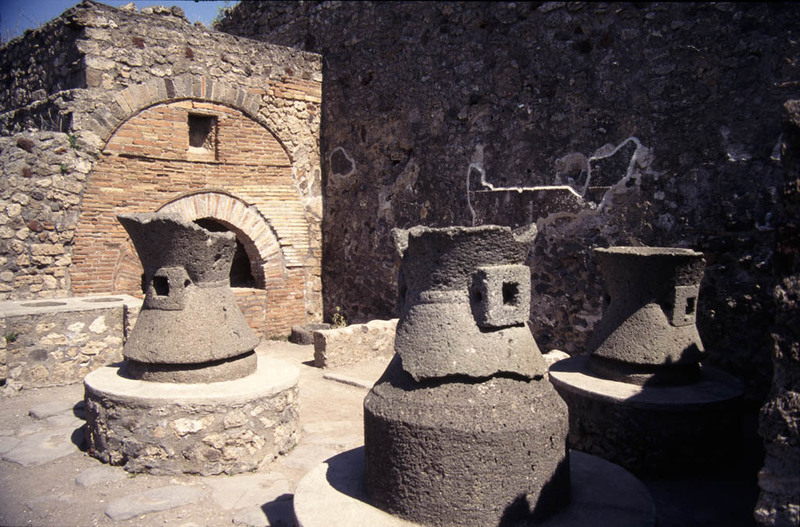
This absence of evidence matters because labor in a bakery was very physically demanding, repetitive, and often exploitative, but the physical evidence, like tools and records, are only reflections of the real people that were working in these bakeries. There is a lot of clear evidence that Roman bakeries were intense work environments. Bakeries excavated in Pompeii included large wood fired ovens, rotary mills that would have been powered by animals as big as donkeys, and tight working quarters. From evidence like images of the Roman bakery, we can reasonably infer that a baker’s work required constant physical exertion: grinding grain, kneading dough, carrying heavy loads, and tending to all sorts of daily chores. It is plausible that Valeria’s body bore the marks of this intense physical labor. Repetitive grinding and kneading could have led to joint strain, and injuries to places like the wrists and back. Body parts essential in caring for her young child.
Outside of the day-to-day work of running the bakery, she would have overseen the care of her young child. From evidence found in the home of a Roman baker in Pompeii, there was wealth in baking. It can be assumed that from the sale of their bread, they would have been in the lower-middle class. They were still working with their hands, tiresome grueling labor for hours a day, but they would have earned a comfortable wage in exchange. Because their lives were controlled by the time and effort required for the bakery’s success, it can be assumed Valeria would have required assistance caring for her child. At the young age of her infant, Valeria probably had a wet nurse who assisted her in the care and raising of the child. Once the child was older, Valeria may take over more of the responsibility of raising the child once they were of age to help with the family business. If the child was a girl, she would have been educated to the same level as Valeria, with the ability to keep books and run a business. A young boy would have probably been assisting with work around the bakery or possibly attending school were the family wealthy enough.
Roman daily life had similarities to today. The work that Valeria did for her family’s business was challenging and crucial to the function of the bakery and the income they earned. She was able to balance handling things such as the books and daily inner workings of the business, along with assisting in the bakery and doing physical labor. All of this work towards the success of her family’s bakery would have been done in tandem with raising her child. She would have also been responsible for a large portion of the work that goes into raising a child. This challenging balance would have consumed almost all of her time, and the expectation for her to be able to do all of this is similar to the expectations women face now. She would have most likely had help, but that would have only relieved a small portion of her workload. Women today have resources as well, but there is still a stigma against handing off parts of the work they are responsible for. Women are expected to do so much, and Valeria’s work during the early first century is still reminiscent of the work women do today in the twenty-first century.
Sources
- Cartwright, Mark. A Pompeii Bakery. 13 Nov. 2012. Penn State Libraries Pictures Collection.
- The Miriam and Ira D. Wallach Division of Art, Prints and Photographs: Picture Collection, The New York Public Library. “Roman bakery” The New York Public Library Digital Collections. 1882. https://digitalcollections.nypl.org/items/643e1b30-c5be-012f-d23c-58d385a7bc34.
- ‘Women in Roman Society’. “Juvenal, Satires 6.434-456.” As the Romans Did: A Source Book in Roman Social History, by Jo-Ann Shelton, pp. 290–307.
- Benton, Jared T. The Bread Makers: The Social and Professional Lives of Bakers in the Western Roman Empire. 1st Edition 2020, Springer International Publishing, 2020, https://doi.org/10.1007/978-3-030-46604-6.
- Kron, Geoffrey. “Comparative Perspectives on Nutrition and Social Inequality in the Roman World.” The Routledge Handbook of Diet and Nutrition in the Roman World, edited by Paul Erdkamp and Claire Holleran, 1st ed., vol. 1, Routledge, 2019, pp. 259–72, https://doi.org/10.4324/9781351107334-21.
- Wasson, Donald L. “Massilia.” World History Encyclopedia, 6 Mar. 2013, https://www.worldhistory.org/massilia/.
- Wilson, Andrew, and Miko Flohr. Urban Craftsmen and Traders in the Roman World. Oxford University Press, 2016.
- Wilkins, John, and Robin Nadeau, editors. A Companion to Food in the Ancient World . Wiley Blackwell, 2015.