Demetrios
The Character
Looking at citizenship, status and equality through the lens of a stonemason
Name: Demetrios
Gender: Male
Age: 35
Status: Freeborn Non-citizen
Family: Married with two children
Occupation: Artisan
Time Period: 20-45 CE
Location: Aphrodisias, Asia
Between Freedom and Citizenship: A Craftsman in the Roman World
by Adian Martinez
Demetrios, a freeborn but non-citizen marble mason from Aphrodisias, lived in a Roman world that was deeply interconnected by trade but that was unequal. Aphrodisias, located in modern-day Turkey, was known for its high-quality marble, making it an important center of production within the empire. As a mason, Demetrios likely spent his day shaping stone that would travel far beyond his city, contributing to monuments, sculptures, and tombs across the Roman world. Although he was free and possessed a valuable skill, his lack of Roman citizenship may have limited his political participation and social recognition. His life existed within this tension of inclusion in the economic life of the empire and exclusion from its full privileges.
Freedom and Movement
While Demetrios is a fictional character, his story is a composite drawn from real evidence and using him helps us understand the experiences of those excluded from power within the Roman Empire. The evidence suggests that status and identity in the Roman world were closely tied to visibility, material display, and legal recognition. One example is the epitaph (a funerary inscription), “Freedman of a Slave Dealer,” which highlights a formerly enslaved man’s pride in his freedom and “honest life.” This inscription shows that legal status mattered deeply, as the individual chose to define his legacy through the achievement of freedom. It is plausible that Demetrios lived in a society where such distinctions shaped how people understood themselves and others. Even though he was freeborn, his lack of citizenship may have placed him in a position of partial belonging, where he could work and participate in local life but might still remain outside of full civic inclusion. However, we cannot know whether Demetrios viewed this as a limitation in his daily life or whether his identity was more closely tied to his local community than to Rome itself.
Mobility played a central role in shaping Demetrios’ world, even if he himself did not travel far. Aphrodisian marble was widely distributed, meaning that the objects he helped produce could have reached distant parts of the empire. This suggests that Demetrios participated in a network of economic and material exchange that connected local labor to imperial-scale production. It is possible that merchants, patrons, or intermediaries facilitated the movement of marble and finished works, allowing Demetrios’ craftsmanship to circulate beyond his immediate surroundings. At the same time, his own mobility may have been constrained by economic limitations, social ties, or legal status. While elites could travel for politics, military service, or administration, individuals like Demetrios may have experienced the empire more through the movement of goods than through personal travel. This contrast reveals how the Roman Empire functioned not only through the movement of people, but also through the circulation of materials and labor.
Power and Status in Material Art
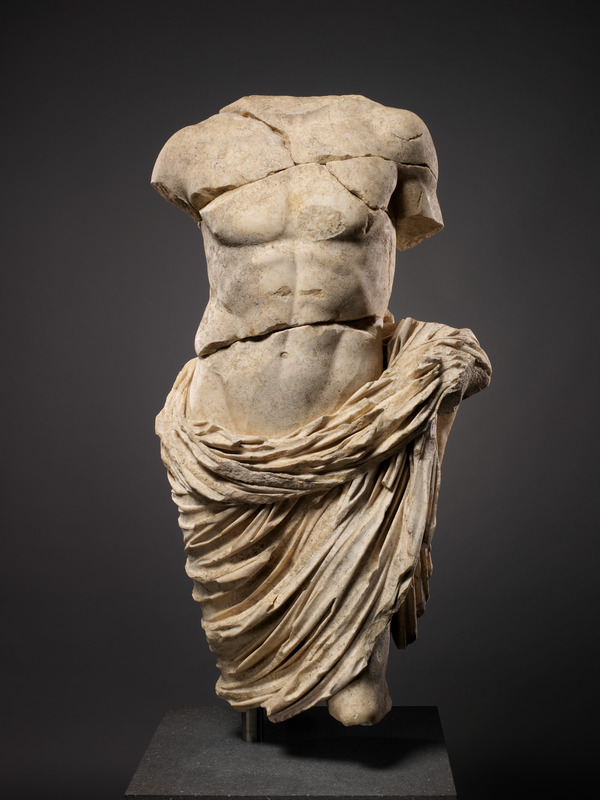
This marble statue of a member of the imperial family, dated to the Augustan or Julio-Claudian period (27 BCE-68 CE), further illustrates the relationship between material culture and power in the Roman world. Statues like this were often displayed in public spaces such as forums, basilicas, or theaters, where they would have been highly visible to a wide audience. The material and placement of these statues suggest that they were meant to communicate authority, wealth, and legitimacy in the imperial system. Unlike smaller funerary objects, this statue represents a form of public recognition that was tied directly to political power and citizenship. As a marble mason, Demetrios may have contributed to the production or maintenance of similar works, meaning he helped create the physical symbols of a system he was not fully included in. It is plausible that he would have regularly seen such statues in civic spaces, reinforcing the presence of imperial authority in everyday life. However, we cannot know how he personally interpreted these displays, or whether he viewed them as distant symbols of power or as part of a system that shaped his own opportunities and limitations.
The limits of the evidence are important to acknowledge. The imperial statue preserves the image and authority of elite figures, but it tells us nothing about the laborers who created it. The epitaph mentioned above preserves the self-representation of a successful freedman, but it does not capture the everyday experiences of those who remained outside of full social recognition. These sources were created by and for individuals with the means to shape how they were remembered, which means they emphasize achievement, visibility, and status while leaving out uncertainty, exclusion, and constraint. As a result, the experiences of people like Demetrios are largely absent from the historical record. This silence is not accidental. It reflects a broader pattern in Roman society, where power influenced not only social position, but also whose lives were considered worth recording and preserving.
Why this Story Matters Now
Demetrios’ story matters because it challenges us to think about how systems of inequality operate beyond clear categories like slavery and freedom. His position as a freeborn non-citizen suggests that belonging is not always absolute, and that individuals can exist within systems that both include and exclude them at the same time. This has clear relevance today, as modern societies continue to grapple with questions of legal status, labor, and recognition. Just as Demetrios may have contributed essential work to a system that did not fully include him, many people today participate in economic and social systems that depend on their labor while limiting their access to rights or recognition. By examining the gaps and silences in the historical record, we can better understand not only the complexities of the Roman world, but also the ongoing challenges of inequality in our own world.
Sources
- Abbe, Mark (2007). Polychromy of Roman Marble Sculpture. The Metropolitan Museum of Art. https://www.metmuseum.org/essays/polychromy-of-roman-marble-sculpture
- Aphrodisias—UNESCO World Heritage Centre. (n.d.). https://whc.unesco.org/en/list/1519/
- Smith, R. S. (2014). Ancient rome : An anthology of sources. Hackett Publishing Company, Incorporated. “Persons of Freed Status”
- Johnston, D. (1999). Roman law in context. Cambridge University Press.
- Raggi, A. (2022). The Civis. In A Companion to the Political Culture of the Roman Republic (pp. 303–317). https://doi.org/10.1002/9781119673675.ch22
- Wilson, A., & Bowman, A. (Eds.). (2017). Trade, Commerce, and the State in the Roman World. Oxford University Press. https://doi.org/10.1093/oso/9780198790662.001.0001