Julia Severa
The Character
An inside look into the life and duties of a Priestess of Isis and the Goddesses’ influence within and outside the mystery cult.
Name: Julia Severa
Gender: Female
Age: 40
Status: Citizen
Family: Married, four adult children, 1 daughter 3 sons
Occupation: Priest/Priestess
Time Period: Second Century CE
Location: Ostia, Italy
The Cult of Isis and Those Within
by Brettlynn Driscoll
Before the transition to Christianity, Ancient Rome was polytheistic, meaning they worshipped multiple gods or goddesses. Depending on the situation or circumstance, you prayed to the god that fit best for what you needed. The goddess Isis was incorporated from Egypt into Ancient Rome. Many Romans accepted her and began praying for her guidance and gifts. There are few written records on the actions within the cult because it was a mystery cult, meaning that its practices remained a secret only for initiates. Therefore a lot of what they did remains speculative. Using a fictional character, Julia Severa, a Priestess of Isis, we can make educated theories based on information we already have on the inner workings within the cult, and how this specific cult impacted the local communities based on information from other documented cults in Ancient Rome. This essay will explore the cult as well as the prominent myths and stories connected to Isis.
The Goddess Isis
The mystery cult of Isis is centered around the ancient Egyptian goddess Isis. She is associated with healing, magic, and motherhood. The goddess’s most celebrated myths involve her mourning of her husband, Osiris, after his death and her efforts to resurrect him, establishing Isis as a protector and healer within mythology. Even though the cult faced repression, it had followers from many diverse social backgrounds, as well as offering rites and ceremonies that focused on community among believers. The temples erected to Isis served as centers for her worship. Many of her miraculous deeds were later linked to Christian figures such as the Virgin Mary. Julia Severa could have prayed and offered gifts to the goddess to make sure she watched over her family and took care of Julia’s child when she was pregnant. After getting positive results, she does her duty and repays the goddess for her good will.
Temple and Courtyard Design
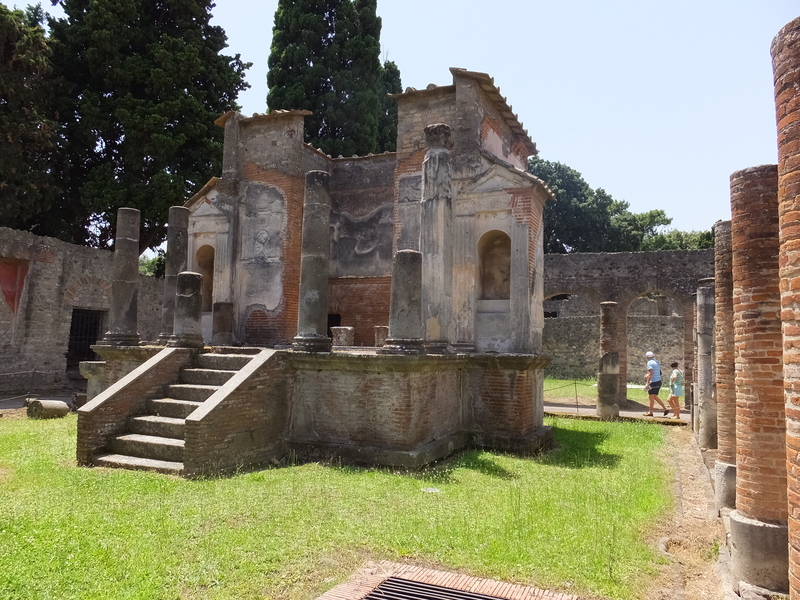
This Temple of Isis was uncovered in Pompeii during an excavation in 1764. The temple itself was originally built during the emperor Augustus’ reign in the late first century BCE, but after an earthquake in 62 CE, the temple was damaged and rebuilt through donations from various members of the community. This temple was built on top of a podium at the center of a porticoed courtyard and within this temple was the pronaos, a porch-like area that is surrounded by columns. There is also a naos, an inner room, which contained the statues of Isis and Osiris. There were also niches on the wall that might have displayed statues of Harpocrates (the child Horus) or Anubis, since both were associated with Isis’s cult. The stairs at the back of the naos lead back into the courtyard that was most likely used by officiants. The southeast corner of the courtyard contained a roofless enclosure called a purgatorium, which contained a basin of water from the Nile used for purification rituals. Lastly, behind the temple was an ekklesiasterion, which was a hall used for gatherings at ritual banquets for the cult. With Julia’s main job of conducting rituals, she would have spent her time at the temple in Ostia in the purgatorium or the ekklesiasterion.
Donations
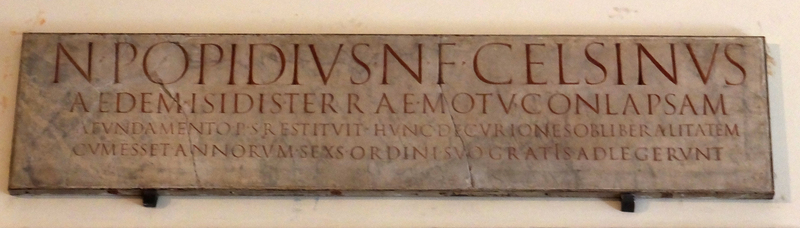
To support the cult worship of Isis, it was critical for the officiants to solicit donations. This image is an inscription of a plaque that is displayed above the entrance of the Temple of Isis in Pompeii. The inscription reads, “Numerius Popidius Celsinus, son of Numerius, rebuilt at his own expense from its foundations the Temple of Isis, which collapsed in an earthquake. Because of his generosity, although he was only six years old, the town councilors nominated him into their number free of charge.”1 Across the street from the temple is another inscription that reads, “Popidius Natalis the client - along with the Isaici [devotees of Isis] - asks for Cuspius Pans for aedile.” There is another inscription on the same insula (an apartment complex) that reads, “All the Isiaci [the devotees of Isis] request Cn. Helvius Sabinus as aedile.”2 The priest and priestesses showed their gratitude for donations by helping to support their donors in elections.
The Goddess’s Influence
In Apuleius’ novel Metamorphoses, there is a story about Lucius and his transformation into a donkey as well as the hardships and challenges he faces and overcomes.3 In Book 11, Lucius finally prays to Isis for his transformation back into a human. Isis appears to him in a vision and promises to save him if he follows her instructions and devotes himself to her service. He agrees and the following day, a religious festival was held in her honor and Lucius follows her directions at this festival. A priest of Isis offers him a garland of roses and when Lucius eats them, he turns back into a human. The crowd at the festival marvels at Lucius’s transformation and he is filled with gratitude and relief that he is back to being a human. He decides to join the religious procession and become a devoted follower of Isis and afterward, he undergoes the initiation into the mystery cult of Isis that involves purification, rituals, and symbolic rebirth, dedicating his life to Isis and gaining spiritual purpose and protection. This story leans into the aspect of Isis as a goddess of motherhood and rebirth. As a priestess, Julia Severa would have gone through similar initiation rituals.
Iphis and Ianthe
Another story connected to Isis is the story of Iphis and Ianthe, a fable about love, identity, and transformation. It begins with Ligdus and Telethusa, who are expecting a child. Ligdus is insistent that if the baby is a girl, she must be killed because they cannot afford a dowry when she gets married. When Telethusa has a girl, she decides to raise her daughter as a son, naming him Iphis to keep the truth hidden. As Iphis grows up, “he” is betrothed to a girl named Ianthe. They fall in love, and with Iphis being a girl, she becomes anxious and sees the marriage as impossible, which creates an intense emotional confliction within Iphis as she desires Ianthe but believes their love cannot be fulfilled. Telethusa, on the eve of her “son’s” wedding, prayed to the goddess Isis for help and in response, Isis performs a miracle that transforms Iphis into a boy. With this transformation, the two lovers are able to marry with the story ending on a happy note. This story would cement the belief Julia Severa and other devotees had in her goddess.
Depictions of Isis
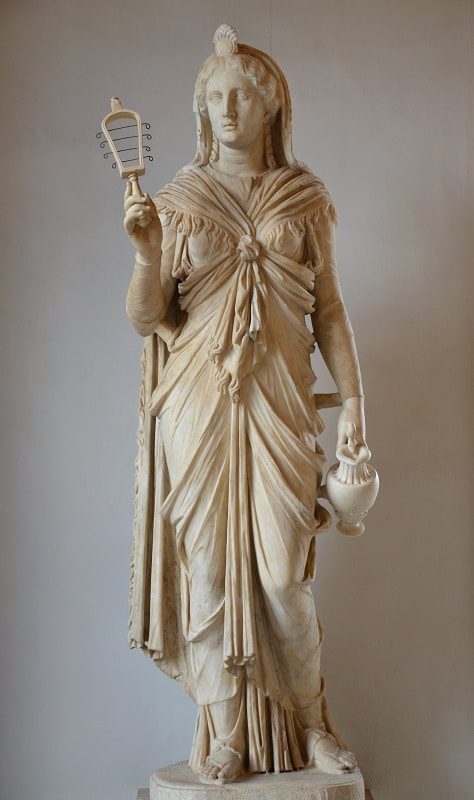
This statue from the Capitoline Museum depicts the goddess Isis. With Isis being associated with magic, fertility, motherhood, and healing, her statue is depicted with those associations outlined. The object in her right hand is called a sistrum, which is a rattle that was used for rituals, music, and dances within the cult of Isis. It was believed to ward off evil spirits and ensure divine protection, as well as invoking the Nile and life-giving energy for those who played the instrument as an elemental tool to invoke the goddess’s power. The object in her left hand is a that is called a situla, which was used as a ceremonial vessel that was often bronze for libations such as pouring offerings of milk or water to the deities and was associated with the goddess and rebirth. On Isis’ head is a combination of traditional Egyptian symbols and Roman artistic styles containing the central sun disk between cow horns that are often depicted as feather plumes, an artistic design borrowed from the goddess Hathor. Finally, she has light but form-fitting clothing to accentuate the curvature of her body to signify her being a goddess of motherhood and fertility as these feminine features are associated with women. It is likely that within these temples, the statue would be present at an altar to give offerings to the goddess which Julia Severa being a devout priestess of Isis would have gone to give her offerings to the goddess.
Duties and Rituals
Isiac priests were those who served the goddess Isis but who originated outside of Egypt. These priests were understood as being a part of the Isiac cults rather than being a part of the purely Egyptian religion since their practices adapted to the new cultural settings. According to the visual evidence, priests of Isis, as well as priests of other gods in the Greek world would be appointed by the city authorities, and many also served as benefactors.
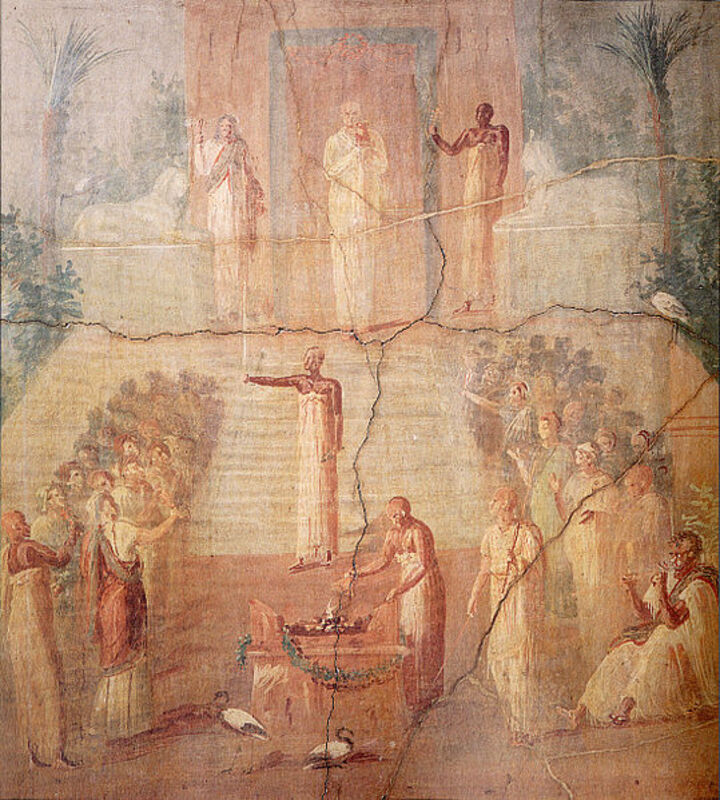
This is an art medium called a fresco, and this is a depiction of a priest carrying out a water ritual in front of a gathering of devotees to the goddess of Isis. A water ritual was a sacred ceremony that involved purification, initiation, and the veneration of the goddess as a life source. The specific mural is from a temple dedicated to Isis in Herculaneum, dated between 62 and 79 CE. This mural is currently a part of the National Archaeological Museum of Naples, Italy collection. With Julia‘s job being overseeing and performing rituals, this would be one of the rituals she would have performed at her temple.
Conclusion
Even though there is not a lot of documented evidence of the mystery cult of Isis, there is other documentation that we have where we can speculate what may have happened within this cult. My character, Julia Severa, would have dedicated her time to the temple and her duties at the temple while her husband worked to support her and her duties at the temple as her position was most likely an unpaid position based on evidence of other priests and priestesses. The cultural aspects of bringing another ogd into a foreign country and accepting it shows great cultural adaptation in Ancient Rome. We can draw parallels in modern times to how people adapt to new cultures they are immersed in.
References
- Apuleius, Lucius. “Lucius Apuleius: The Golden Ass.” Translated by A.S Kline. Apuleius (c.124–170) - The Golden Ass: Book XI. Accessed May 4, 2026. https://www.poetryintranslation.com/PITBR/Latin/TheGoldenAssXI.php#anchor_Toc353982290.
- Artist, Unknown. “Roman Mural of ISIAC Cult.” World History Encyclopedia, November 20, 2017. https://www.worldhistory.org/image/7654/roman-mural-of-isiac-cult/.
- Cosette. “Connecting with the Egyptian Goddess Isis.” Divine Hours Spiritual Support for Soulful Living, July 20, 2023. https://cosettepaneque.com/connecting-with-the-egyptian-goddess-isis/.
- Martzavou, Paraskevi. “Priests and Priestly Roles in the ISIAC Cults: The Case of Roman Athens in a.Chaniotis (Ed), Ritual Dynamics in the Ancient Mediterranean; Agency, Emotion, Gender, Representation, Stuttgart, (2011) 61-84.” Academia.edu, May 8, 2012. https://www.academia.edu/1542571/Priests_and_priestly_roles_in_the_Isiac_cults_the_case_of_Roman_Athens_in_A_Chaniotis_ed_Ritual_Dynamics_in_the_Ancient_Mediterranean_agency_emotion_gender_representation_Stuttgart_2011_61_84.
- Ovid. “The Internet Classics Archive: Metamorphoses by Ovid.” Translated by Samuel Garth and John Dryden. The Internet Classics Archive | Metamorphoses by Ovid. Accessed May 4, 2026. https://classics.mit.edu/Ovid/metam.9.ninth.html.
- Strabley, Eloise. “Temple of Isis at Pompeii – Religions of Greece and Rome: Site Reports.” Religions of Greece and Rome. Accessed April 28, 2026. https://openpress.digital.conncoll.edu/religionsofgreeceandromesitereports/chapter/temple-of-isis-at-pompeii/.
- Tellier, Cassandra Lee. “Cult of Isis: History: Research Starters: EBSCO Research.” EBSCO, 2022. https://www.ebsco.com/research-starters/history/cult-isis.