Lucius Cornelius Crispus
The Character
A look into the daily life of a Roman fullo, and how their job would have affected their lifes.
Name: Lucius Cornelius Crispus
Gender: Male
Age: 35
Status: Citizen
Family: Married, no children
Occupation: Artisan
Time Period: 10-30 CE
Location: Misenum, Italy
The Smell of Work: Labor and Status in the Life of a Fullo
by Logan Priest
During the Roman Empire, clean clothing was a necessary piece for status. Clean, good-looking togas were a symbol among Roman elites. However, the labor required to clean the clothes was looked down upon in Roman society. In this essay, I introduce Lucius Cornelius Crispus. He is a fictional character based on historical evidence. Lucius is a thirty-five-year-old Roman citizen who lives in the Italian port town of Misenum. He has a wife but no children. He works as a fullo, or fuller. Fullo’s are individuals who cleaned and finished clothing. The space that he would have worked in would have been called a fullonica or fullery. His job could have created some discourse in his social life and how he would have moved through society. I combine archeological and textual evidence, alongside critical fabulation to better understand how the lives of ordinary workers could have been affected by their job during the Roman Empire.
Introduction to Misenum
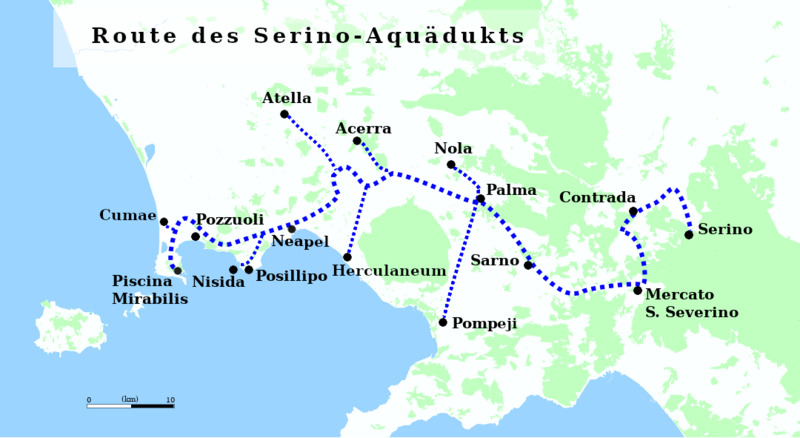
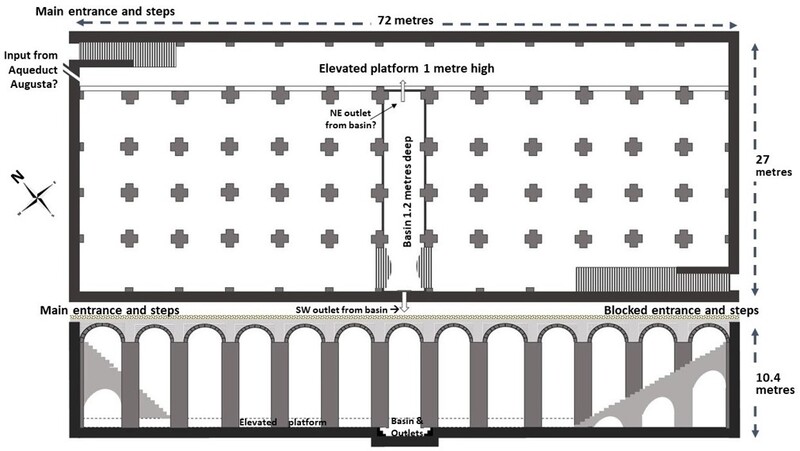
Despite the sophistication of Roman engineering, access to water would have been the single most important thing to Lucius, because it was so critical for his job. Lucius is from the port town of Misenum, located on the western coast of Italy in the Gulf of Napoli. Access to clean water was not guaranteed in this area. That was until the Augustan Aqueduct was built. Figure 1 shows us a map with a possible route for the Augustan Aqueduct. This map shows the aqueduct going to Misenum to supply water to the people who lived there. Because of Misenum’s location it was made into one of the main naval stations in the Mediterranean by Agrippa in 31 BC.1 This means that this city would have been a very busy place after the naval station was placed there. This means that water would have been important to all because they needed a very large supply of it. This necessity for water is what could have sparked the construction for the Piscina Mirabilis, a massive cistern designed to supply water to the people in Misenum and the surrounding areas. When it was full, it held over 14,500 cubic meters of water.2 Figure 2 shows us what the inside of the Piscina Mirabilis looks like and how the water would have come in and out of the cistern. Water was a huge part of the ancient world, and that is why Lucius could have been anxious about it.
Visualizing Labor
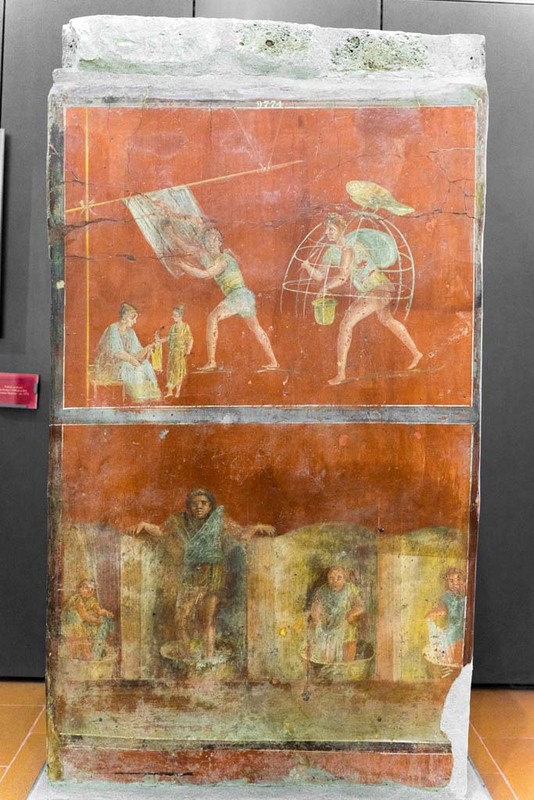
Lucius’s job would have been very labor intensive. The processes used to clean clothes were multi-stepped and involved collaboration with others. We know this because of the frescoes from the Fullonica of L. Veranius Hypsaeus in Pompeii, Italy. Figure 3 is one of the frescoes that shows some of the work that would have been completed by fullones. Within the fresco, we see the individuals hard at work doing a variety of different tasks. We can see examples of what the treading vats would have looked like, as well as some of the drying processes that were used. fullones would have first soaked the clothes in solutions derived from urine. They then would have moved the soaked clothes over to the treading vats to remove the oil and dirt. Then they would have been rinsed and dried.3 The process could have been repeated if the results weren’t up to the standards. This scene highlights something that was not written down. The labor that was involved in fullery was skilled and physically demanding. Aspects of his Lucius job would have associated him with some stigma. His labor would have been looked down upon in Roman society. Not only would he be stigmatized from his job itself, the odor that was associated with fullery works could have also made him a bit socially stigmatized.4
Smells and Status of a Fullo
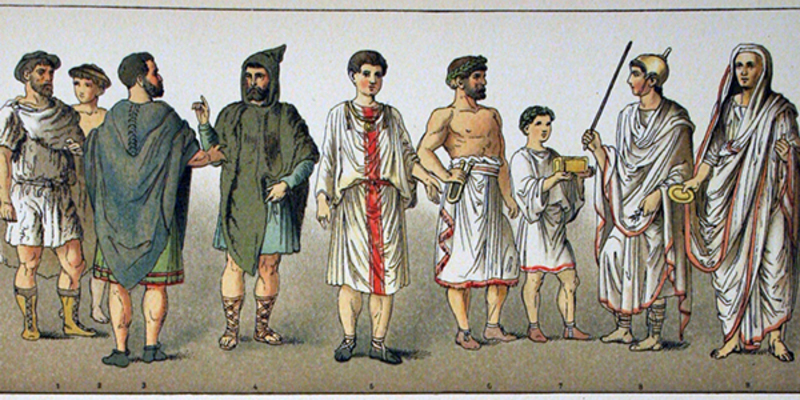
Lucius could have been in a strange spot because of this. His work was necessary; everybody needed to get their clothes cleaned. Yet, it was closely linked to manual labor and dirty work environments. His citizenship would have helped him a little bit though. He would have been granted the same legal rights. Figure 4 shows some typical men’s wear from the Roman empire. All of the men wearing white could have possibly relied on a fuller, like Lucius, to keep their clothes clean and white. Even with the same legal status, it’s possible that he could have been cast aside because of the nature of his work.4 This tension highlights how Roman status was not only about legal standing it was also about what kind of work you did and how visible it is to the public. This point is also visible when you look into Eumachia. She was a wealthy priestess and a patron for the fullos. She funded a large building in Pompeii that is closely associated with the fullers guild. As Lucius worked in the workshop, figures like Eumachia would have operated within the public eye. Her involvement with the fuller’s guild suggests that they were economically significant to Roman society to warrant patronage from the elites, even though their work remained socially stigmatized.5
The Fullonica as an Environment
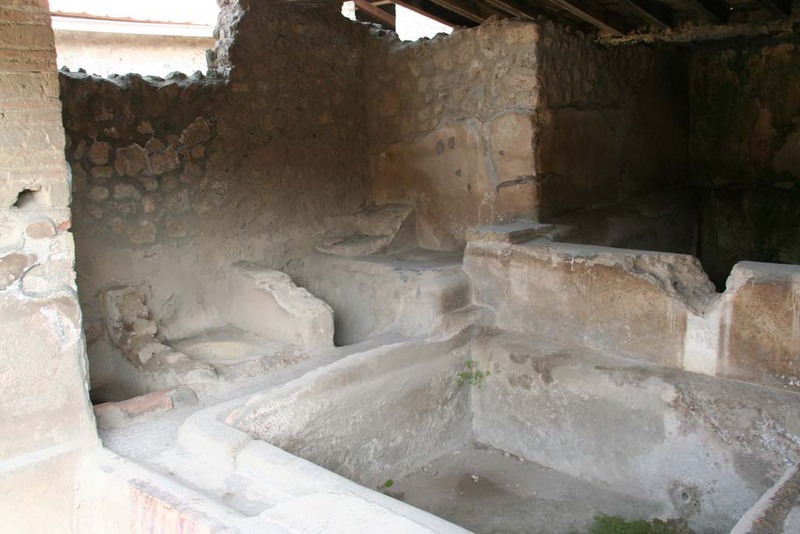
The archeological remains of fullonica presents useful information about the environment that Lucius could have worked in. These spaces were carefully designed and well thought out workspaces to maximize efficiently. We have a few examples of Fullonica that are located in Pompeii. These facilities are all laid out differently, but the actual features would have been similar, depending on how big or small the fullonica was. Typically, they would have had a small or large basin to soak the clothes in, small treading vats to remove the excess cleaning solutions and grime left on the clothes after soaking, as well as places to hang and dry the clothing after the process is complete. The facilities also often had channels and pipe systems for moving the water in and out of the workshops.6 In figure 5, we can see an example of a soaking vat from the Fullonica di Stephanus in Pompeii. In the background of this you can also see some examples of the treading stalls, and the channel system that would have helped facilitate the movement of water to help keep the workshop as clean as it could be.
Water access would have played a crucial role in the completion of Lucius’s daily tasks. What I mean by water access is that the workshop that he works in has a steady reliable source of clean water. He would have needed this water to soak the fabrics to loosen the dirt and oils and for rinsing out the cleaning solutions used. Without reliable access to water, the quality of his work could have been seriously compromised.
The Piscina Mirabilis and the Augustan Aqueducts are prime examples of the ties between infrastructure and economic survival. These structures were feats of engineering that could have shaped the income stability and the quality of Lucius’s work. The aqueducts and the cisterns that are spread across the Roman empire were a lifeline and a constraint. They would have delivered water to people, but that water would not have delivered equally. The access could have not been equal and the workers like Lucius would have remained vulnerable to how it was distributed and allocated.
#/media/File:Route_des_Serino-Aquädukts.png)
Conclusion
The life of a Roman fuller, like our character Lusius, highlights a contradiction within Roman society. His job was viewed as necessary but then also simultaneously devalued by those who deem it necessary. The visibility and the sensory associations with his job created a form of social distinction that could not be erased by his citizenship alone. These dynamics have made an impact on how Roman society is viewed today. The roman emphasis on how public appearance and occupational hierarchies continues to shape how some current societies understand labor and social value based on occupation. This is represented today in some labor systems being labeled as undervalued. The story of a fullo does more than help reconstruct the ancient past. It helps us understand how Roman values about labor have echoed into modern labor values.
Disclosure- Grammarly AI was used in this essay for grammar and punctuation edits only.
Image Sources
- Eber, J. (2021, July). Fresco from the fullonica of L. Veranius Hypsaeus in Pompeii, Italy. Pompeii in Pictures. https://pompeiiinpictures.com/pompeiiinpictures/r6/6%2008%2020%20p2.htm
- File:Route Des Serino-Aquädukts.png - Wikimedia Commons. 3 May 2021, commons.wikimedia.org/wiki/File:Route_des_Serino-Aqu%C3%A4dukts.png.
- Heese, K. (2013, April). Image of an interior workshop from the Fullonica di Stephanus in Pompeii, Italy. Pompeii in Pictures. https://pompeiiinpictures.com/pompeiiinpictures/R1/1%2006%2007%20quickie.htm
- Roman Aqueducts | Global Network of Water Museums*. (n.d.). https://www.watermuseums.net/heritage/valuing-ancient-water-cultures/roman-aqueducts/
- Roman fashion, The Average citizen to the Emperor – Talia Rouck*. (2018, September 19). https://eportfolios.capilanou.ca/taliarouck/2018/09/19/roman-fashion-the-average-citizen-to-the-emperor/
- The Archaeology Roadshow. (2022, April 28). The Piscina Mirabilis: Water for Misenum | AR. AR. https://archaeologyroadshow.org/the-piscina-mirabilis-water-for-misenum/
Sources
-
Britannica Editors. “Misenum”. Encyclopedia Britannica, 17 Oct. 2016, https://www.britannica.com/place/Misenum. ↩
-
The Archaeology Roadshow. (2022, April 28). The Piscina Mirabilis: Water for Misenum | AR. AR. https://archaeologyroadshow.org/the-piscina-mirabilis-water-for-misenum/ ↩
-
De Feo, G., and S. De Gisi. “Water and wastewater management in the treatment process of a Roman Fullonica.” Water Science & Technology, vol. 13, no. 3, 2013, pp. 599-605. DOI: https://doi.org/10.2166/ws.2013.003. ↩
-
Flohr, Miko. “Fullones and Roman Society: A Reconsideration.” Journal of Roman Archaeology [Portsmouth, RI, USA], vol. 16, 2003, pp. 447–50, https://doi.org/10.1017/S104775940001326X. ↩ ↩2
-
Discentes. “The Building of Eumachia and Female Patronage in the Roman Empire.” Discentes, 13 Feb. 2025, web.sas.upenn.edu/discentes/2025/02/12/the-building-of-eumachia-and-female-patronage-in-the-roman-empire. ↩
-
Flohr, Miko. The World of the Fullo: Work, Economy, and Society in Roman Italy. OUP Oxford, 2013. ↩