Maximus
The Character
Maximus, 35, cart driver, non-citizen, unmarried, skilled, owns a slave, works for the Roman Army, has son who wants to join the Auxiliary forces to earn citizenship, lives in Augusta Treverorum
Name: Maximus
Gender: Male
Age: 35
Status: Non-citizen
Family: Unmarried with Son
Occupation: Cart Driver
Time Period: 130 CE
Location: Augusta Treverorum, Gaul
The Men behind the Army
by Brady Viohl
It was not just armies and generals that kept the Roman Empire at its peak, but everybody behind them. Non-combatants, which consisted of slaves, non-citizens, and other laborers, accompanied the soldiers and filled many roles that were necessary to the success and survival of the Roman legions. Maximus filled one of these roles as a cart driver. Living nearby, the Rhine was an important borderland region that had a significant military presence for that reason.1 A place like this would need to be constantly resupplied, and that is where Maximus comes in. While being employed by the military, Maximus is not a citizen, meaning that he may be important, but not fully recognized legally or afforded the same rights.
Maximus is Germanic and freeborn, which gives him more rights than a slave, but significantly less than a citizen. Because of his skill and age, he is a modestly paid cart driver for his profession, but still makes less than a common soldier. He is not elite in status or in wealth, but he makes a decent living. He owns 20 iugera of land (13 acres) with space that likely supported animals, storage, and transport needs connected to his work. He owns one slave, Segimerus, who works on the land with Maximus’s son Lucius. Lucius, who is 18, plans to join the auxiliary forces, which were non-citizen military units that could earn citizenship after service.2 Auxiliary forces were typically soldiers that functioned as archers or light infantry and usually made up about half the army’s numbers. Serving in the auxiliary forces was one of the only ways to gain citizenship if you were not rich.3
Maximus fills an important role that often goes unseen. The Roman Empire depends on people like him to function, but at the same time it does not give them the same status or protection as the people who fight for it. That contradiction is what makes him useful for understanding how Rome actually worked.
The system of Non-combatants
While Maximus is good at his job and is important, he is one of many. He is just a cog in a large machine that keeps the Roman army functioning. Armies require constant supply, and they would be crippled without it. Things like food, building materials, animal feed, tools, and many other resources had to be transported over long distances regardless of the weather. Logistics are not just an important part of warfare, but one of the only things that make it possible.
Roman armies did not rely on one single method of supply. They used a combination of local resources, long-distance transport, and organized systems of movement. This means that logistics were flexible, but also complicated. Supplies had to arrive at the right time and in the right place, which made the people moving those supplies extremely important.
Given where Maximus lived and worked, his job was in higher demand than in many other Roman provinces. Northern Gaul was an area where troop movement and frontier pressure often created a need for supplies, especially during the reign of Marcus Aurelius. Cassius Dio described unrest and instability in frontier regions during this period.4 The demand for supplies certainly kept Maximus employed.
Augusta Treverorum is located at a middle point between the safety of Roman territory and the more dangerous parts of the Roman frontier. Maximus would be constantly moving in and out of danger. We cannot know exactly how Maximus felt about this work, because people like him rarely left written records, but we can still understand the importance of his labor through military evidence and archaeology.
What Maximus actually does
Maximus is a very skilled cart driver. Given his knowledge of seasonal road conditions, he is trusted with important deliveries and is relied on for consistency. Instead of choosing his own work, he is assigned tasks by the military, which means that what he does is based on military need rather than personal choice. These routes likely move from Augusta Treverorum toward the Rhine frontier, supplying forts and military positions that depend on regular deliveries.
The things that Maximus would have likely hauled are very diverse and maybe even surprising. Some things would include grain, salted meat, animal food, tools, weapons, replacement equipment, building materials like timber and stakes, tents, medical supplies, clothing, and even wine.5 Armies required far more resources than you might think, and the majority of them were essential for survival and campaign success. Vindolanda tablets from the Roman frontier also show written requests for goods and supplies, which helps confirm how constant these needs were.6
Given the sheer variety of goods that Maximus would have to deliver, he would have to be highly skilled and versatile. Not only that, but he would have to know how to drive multiple different types of carts depending on the situation. His vast knowledge of hauling would also be invaluable during unpredictable weather. He would have to know when to change routes, or reduce speed to avoid damages or injury. All these factors are what make Maximus a trusted cart driver, because if he fails it can lead to soldiers and animals not being fed, equipment left without repair, or fortifications not being completed.
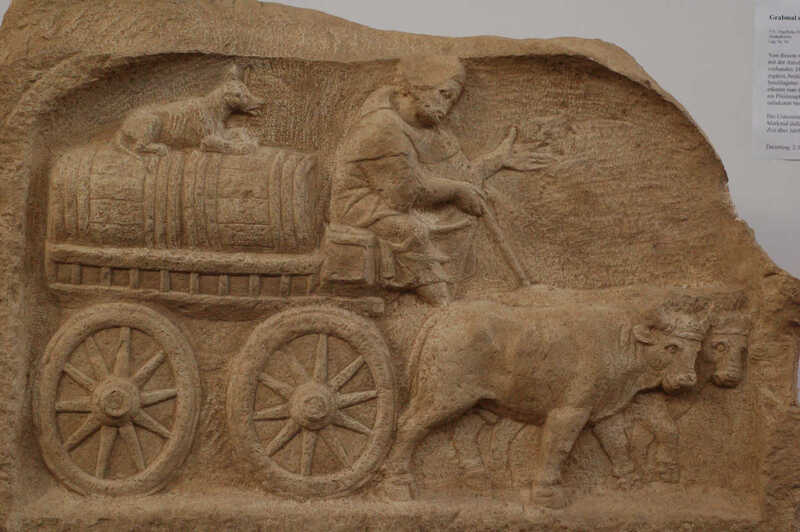
This image shows a Roman ox cart carved into a grave monument, which gives a visual representation of some types of transport used in the Roman world.7 The cart is large, animal-driven, and built for carrying heavy loads, which matches the type of work Maximus would be doing.
While this doesn’t give us very much information about Maximus in general, it does give us a visual representation of his everyday work. Because it is engraved on a tombstone, it could have been commissioned by an actual cart driver. We cannot know that for certain, but it still shows how transport labor could be important enough to memorialize.
Status, Power, and Treatment
Maximus is in a complicated position when it comes to status. He is freeborn, which puts him above slaves, but he is not a citizen, which limits his rights. When working for the military, this difference becomes even more important.
The Roman denarius was the standard currency in Rome. Maximus’s salary was between 200–300 denarii, which is just below that of a common soldier. His skill and experience are the main factors in him having such a modest salary. With that salary he more than likely was put in charge of less experienced cart drivers and some slaves. His age is also another factor in his favor, given that he is still in his physical prime (35), however his job is laborious and likely would have put a strain on him over the years. His experience could play a large role in how he is treated, though that’s not something we can assume.
Working for the military certainly has its advantages, such as stability, but Maximus would be under far more restrictions than if he worked independently.8 It would be unlikely that he would be allowed to leave or refuse work, and definitely not during conflict. His position may be stable, but it comes at a cost.
Maximus is in the awkward position of being important and vulnerable. He is needed for the war machine to operate, but he does not have the luxury of protections that the people he supports have.9
Why it Matters Today
If we look at modern times through the Roman lens, we can still see a lot of parallels. We tend to focus on the Roman emperors, soldiers, and generals, but never the cart drivers, or the potters, or the farmers. Maximus shows us that, unfortunately even today, being essential to a system does not mean a person will be recognized by the system. People in logistics and supply work are often only noticed when something goes wrong.
By looking at Maximus, Roman history becomes less about famous men and more about the ordinary people who made the empire possible.
Sources
-
John F. Drinkwater, Roman Gaul: The Three Provinces, 58 BC–AD 260 (Ithaca, NY: Cornell University Press, 1983). ↩
-
RIB 2401.2, “Military Diploma (Bronze Inscription),” Roman Inscriptions of Britain Online ↩
-
Greg Woolf, Becoming Roman: The Origins of Provincial Civilization in Gaul (Cambridge University Press, 1998). ↩
-
Cassius Dio, Roman History, bk. 72. ↩
-
Jonathan P. Roth, The Logistics of the Roman Army at War (264 BC–AD 235) (Leiden: Brill, 1999). ↩
-
Vindolanda Tablets 343 and 346, Vindolanda archaeological writing tablets collection. ↩
-
“Transport and Travel in Ancient Rome,” Imperium Romanum; “Raeda,” Encyclopaedia Britannica. ↩
-
Jonathan P. Roth, The Logistics of the Roman Army at War (264 BC–AD 235) (Leiden: Brill, 1999). ↩
-
Greg Woolf, Becoming Roman: The Origins of Provincial Civilization in Gaul (Cambridge: Cambridge University Press, 1998). ↩