Sexuality in The Roman Empire
The Character
Sexuality in the Roman Empire and how that was the center of a young woman's life
Name: Sexuality in The Roman Empire
Gender: Female
Age: 21
Status: Freedperson
Family: Husband and one son
Occupation: Merchant
Time Period: 50-67 CE
Location: Pompeii, Italy
Sexuality in Rome: Claudia Vitalis
by June Hall
Introduction
In the early mornings of Pompeii a young freewoman named Claudia Vitalis begins her day before sunrise. Around twenty one years old she is married to a man who was once her master, and is now raising her young son with him. Vitalis’s work as a bread maker places her in the center of Pompeii where she is intertwined with labor, social interaction and reputation which are all closely connected. Vitalis’s life below reflects the realities of a freedwomen in the Roman Empire where freedom did not necessarily mean independence especially in the matters of labor, status and sexuality.
This project explores how Claudia Vitalis might have experienced sexuality through her work and social environment. Rather than trying to understand sexuality through private acts, but rather her experience and how it is shaped by economic survival, power dynamics and visibility. Through her labor, movement and the world around her we can understand how sexuality functioned on a day to day basis within the Roman Empire.
Life in public
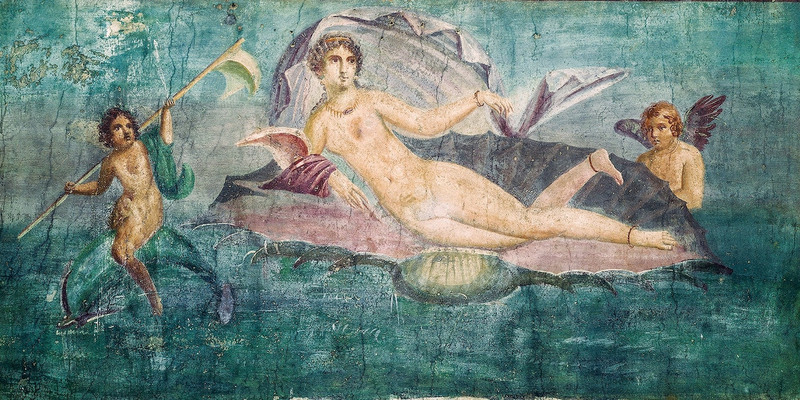
Claudia lived in the city of Pompeii where her daily life showed itself in public spaces. As a bread maker, she woke up in the early mornings to prepare her baked goods and secure her favorite spot in the market. Her work was amongst the other laborers, customers, and traders. Thus exposing her to constant interactions. Unlike the elite Roman women, who were often confined to privacy, taking care of the children and being on their husband’s arm when the time came, Claudia’s life was highly visible. As Gender, Domesticity and the age of Augustus notes, “the ideal Roman woman was associated with the private, domestic sphere.” This idea highlights how unusual Claudia’s life would have been. Unlike elite women, her work required her to be constantly visible in public spaces.. Her marriage complicates her position. Though Vitalis is legally free, her relationship with her once master shows a power imbalance. Her role as a mother suggests stability, but it does not erase the social stigma that is attached to her past. Within the Roman Empire, sexuality is not just about desire, but about status, perception and survival. As seen below, Aphrodite is sitting on a shell. The image below can be seen as an idealized view of beauty, which helps prove Claudia’s experience. As a freedwoman who worked in public, visibility was something she was always exposed to. Rather than admiration, it was more likely judgement.
Moving Through Pompeii
Mobility is a central part of Claudia’s life and work. Claudia must travel through the city to sell her bread, and may also need to move throughout Rome to acquire such ingredients such as grain or flour. These movements place her within the aspects of trade networks that connect Pompeii to other parts of the Roman world. However, mobility reveals inequality in the Roman world. While the movement does create economic opportunity, it also exposes her to risk. As a woman traveling for work, she faces dangers that can be either physical or social. Her ability to move is created by the resources around her, her gender and her status as a freedwoman. Mobility is not just about movement, but the limitation her gender creates.
Sources collected in Homosexuality in Greece and Rome suggest that some of the acceptable behavior in Roman society depended on maintaining social hierarchy. This extends to movement, because it focuses on how people traveled safely, freely and how their movement was perceived. Claudia’s mobility, like her labor, reflects limitation. Not just because of her status as a freedwoman, but her overall power in the world she lives in. Not only that, but status is challenged with the social hierarchy. There is already a power imbalance between her husband and herself. Similarly, Sexual Morality in Ancient Rome states that sexual behavior was closely tied to public reputation. Which means that Claudia could have interacted with customers who were subject to social evaluation same as herself.
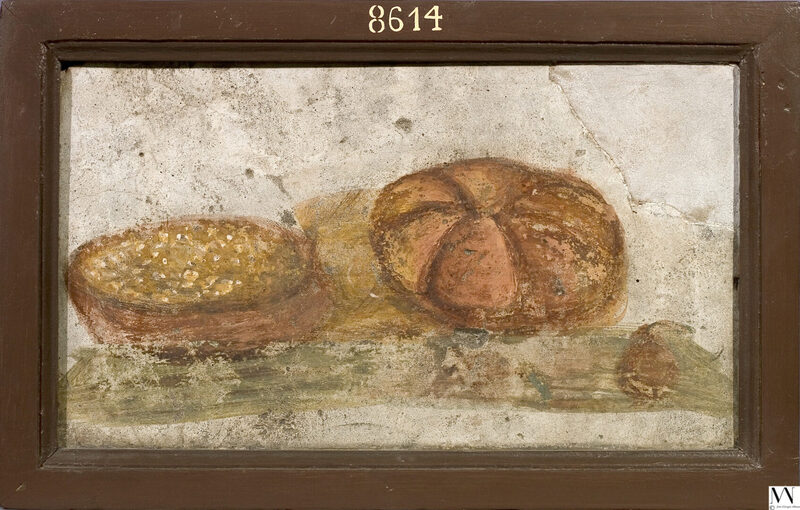
Above is a Fresco depicting loaves of bread. While it does not follow the same theme of sexuality, gender and roles within Roman society. It is a product of hard work, labor. Something Claudia, as a bread maker, dealt with from day to day. Labor and status were challenged on a day to day basis because of Claudia’s status as a freedwoman, and her overall perception amongst her customers.
Claudia’s story challenges modern assumptions about work, sexuality and freedom. Legal freedom does not always mean full freedom, especially for women. Claudia’s experience shows that sexuality is deeply connected to social structures, not just individual choice. By examining her life, we can have a better understanding of how her power, labor and gender shaped everyday experiences in The Roman world. The perspective encourages us to think critically.
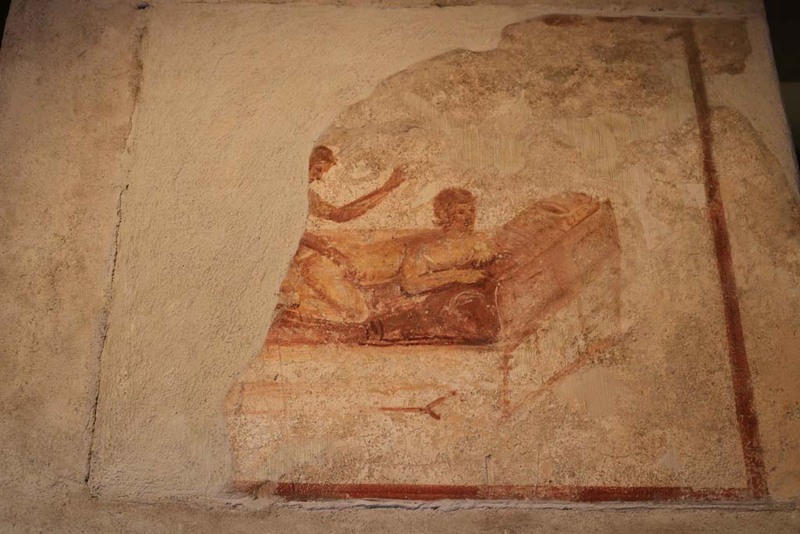

Seen above is a Fresco depicting two male figures in an intimate setting. The Fresco represents sexuality. The scene above reflects human interaction, which was a daily aspect of the Roman culture. For a working freedwoman like Claudia, was exposed to or dealt with her own sexuality. While, there was oppression with sexuality, including masculinity.
What We Know
As Argument with Silence: Writing the history of Roman Women says “the lives of women in antiquity are often fragmentary and difficult to reconstruct.” We know that Claudia was a freedwoman, a wife, a mother, a bread maker and a laborer. However, we do not know her thoughts, emotions, feelings and the true nature of any of her relationships. Evidences suggests that her life was involved in complex systems of power, legal, social and economic issues. Her marriage may have had some affection, and obligation. Her work may have brought both independence, but also responsibility. While these can be assumed, we will never really understand.
Why Claudia’s Story Matters
Claudia Vitalis’s life as a bread maker in Pompeii shows where status, labor and sexuality are deeply intertwined. Her experience shows that freedom was limited by social expectations and economic realities. By looking closely at her life, we can see that the Roman world was not defined by who did what, but by overall social status. Someone with a wealthy status was seen as powerful, while someone poor was seen as weak. While her status is truly unknown, we know from evidence that freedwomen were not seen the same as a wealthy woman.
Claudia’s experience reveals a different Rome. Instead of the peoples view of emperors, gladiator fights and a city covered in Ash. We can see a variation of freedom, labor, inequality, sexuality, work and social status.
Although the Roman world is far different than what our world is today. We can take the evidence historians have found, and see that there were moments in time where the Romans had similar lives to us. Within households there are struggles with domestication, gender, sexuality, labor and social status. At the work place there are ways to climb the career ladder. We have come so far into the world we know now, but if it wasn’t for the past that we have begun to uncover we would never know where we came from.
Sources and further reading
- Williams, Craig A.. Roman Homosexuality : Second Edition, Oxford University Press, Incorporated, 2010. ProQuest Ebook Central, https://ebookcentral.proquest.com/lib/uidaho/detail.action?docID=4938704.
- Homosexuality in Greece and Rome : A Sourcebook of Basic Documents, edited by Thomas K. Hubbard, University of California Press, 2003. ProQuest Ebook Central
- Langlands, Rebecca. Sexual Morality in Ancient Rome, Cambridge University Press, 2006. ProQuest Ebook Central
- Milnor, Kristina. Gender, Domesticity, and the Age of Augustus : Inventing Private Life, Oxford University Press, Incorporated, 2006. ProQuest Ebook Central
- Richlin, Amy. Arguments with Silence: Writing the History of Roman Women. University of Michigan Press, 2014. Project MUSE
Sources for pictures
- Hughes, Bettany. “What the Cult of Aphrodite Reveals About Ancient Attitudes Towards Love—and Desire.” History, 9 Jan. 2025, www.nationalgeographic.com/history/article/aphrodite-greek-goddess-love-desire.
- “Il Cibo a Pompei E Nell’Italia Antica.” Rainews, 22 Jan. 2015, www.rainews.it/archivio-rainews/articoli/Il-cibo-a-Pompei-e-nell-Italia-antica-9bac8a38-9985-449e-a262-4f4942248aed.html.
- PompeiiPictures. 23 Dec. 26AD, pompeiiinpictures.com/pompeiiinpictures/R7/7%2012%2018.htm.