Marcus Aurelius Felix
The Character
A Centurion on the Danube Frontier encountering regional auxiliary forces
Name: Marcus Aurelius Felix
Gender: Male
Age: 38
Status: Citizen
Family: Local woman and two children
Occupation: Soldier
Time Period: 130-150 CE
Location: Apulum, Dacia
Auxiliaries, Citizens, and Rome As a Cultural Force
by Andrew Thomas
The Roman marching camp was the lifeblood of small-unit organization during most of Roman history, but especially around the time of the high empire. This was the place where they would rally at night, leave from in the day, defend in battle, and leave in victory. Though this was dependent time period as they became less mobile and more permanent structures. No matter the makeup of the soldiers, if the formation belonged to Rome, then the marching fort would follow close behind. Auxiliary troops, Roman troops, and every type of soldier in-between would understand this building at a fundamental level if they were in the Roman army.
Marching camps are not distinctly Roman, but they were used heavily by them. But Romans were not the only ones who used them. Rome’s auxiliary forces used them as well. The Roman fort is really a wonderful way to introduce the Roman auxiliary. Two things, not distinctly Roman, co-opted by Rome and put to work in their specific way. As Rome left the borders of Italy, it needed more manpower. By the time that this paper is exploring it had done so well in the past. It needed more manpower if for nothing else than to watch the borders. It needed non-citizen troops. It needed auxiliaries , men of the provinces who were recruited under the promise of pay whether through coins or citizenship.
Auxiliaries were an integral part of the Roman military and showcase how Roman culture dominated local ones. To clearly illustrate this, we will look through the eyes of a fictional character, Marcus Aurelius Felix. Felix is an amalgamation of many pieces of evidence and constructed to show us a clearer understanding of the Roman world. He is a centurion in command of a century on the Danube. Within his unit he has many men who were once members of the auxilia. In the camp there are many auxiliary units. Auxiliaries make up a large part of his daily life.
The Role of the Auxiliary
Roman auxiliaries were a normal part of military life, especially on the frontiers. I They served in many roles, including the same ones those in the legions did. Some were frontline fighters, others were engineers. They were both a military force and a force dedicated to internal security . They fought in battles, eased unrest, and sat in garrisons like most Romans. But they also did things that the Romans themselves could not.The Auxilia were employed mainly in roles that normal Roman soldiers did not take.
Rome did not have a good light infantry tradition, so auxiliaries were integrated. Rome did not have a good cavalry tradition, so auxiliaries were used. Rome did not have exceptional ranks of archers, so auxiliaries were used. They were not temporary, but specialized.

This man’s name was Gemellus. He served his twenty-five years in the auxilia and was granted citizenship after the fact. This diploma is both evidence of that and of the draw that many felt towards the auxilia as a force. It is a path to citizenship, to status, to a better life.
Gemellus and Felix very well could have encountered each other. Felix could have seen a young auxiliary work his way through his enlistment. And in the end, when Gemellus left Felix could have seen the man come back with a new name and a spot within the legion. Though rare, such an event was know to happen. Mobility was forthcoming for an auxiliary once they became a citizen. But even before that they could be quite mobile within the auxilia.
Mobile in Both Rank and Place
The mobility of an auxiliary followed much the same structure as the mobility of a legionary. Auxilia troopers were under a centurion, the unit leader, optio, the second in command, decanus, what would amount to a sergeant in a military today, and all the rest of the military ranks of the Roman army. Likewise, this meant that they could ascend these ranks. An auxiliary could, feasibly, become a centurion. But that is also where mobility ends.
Auxiliaries, much like legionaries, could not lead their own units. Unlike modern militaries with routes for a soldier to become a general, Rome’s general positions were reserved for wealthy men. The highest a rank a legionary could hope to achieve was that of centurion. Auxiliary forces were likewise limited to the same level. An auxiliary trooper could rise all the way to first centurion, but he was still subordinate to whoever was leading the rest of the forces. 1
Aside from that, the actual mobility of an auxiliary force depended largely on the orders of the legion. They could reasonably be expected to march twenty miles a day with full gear. Men couldn’t simply wander away from the formation because they were soldiers. They had to go and do what they were told just as the Romans that they served with had to. And they often died doing that as some soldier do. But those who don’t advance through the ranks, eventually making it to the loftiest command they could.
Calvary Tombstones
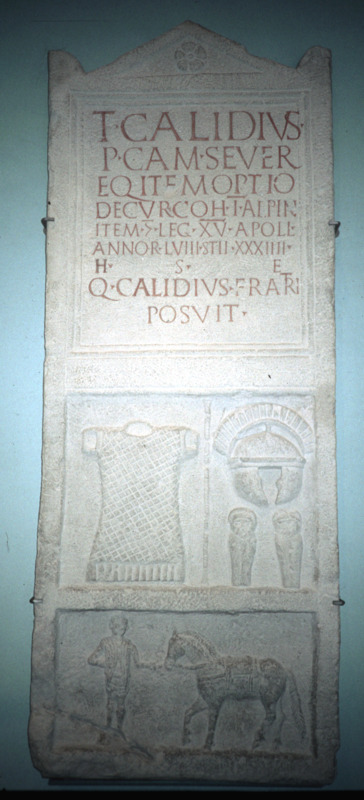
Pictured above is the tombstone of a cavalryman who served thirty-four years within the Roman military. After his prerequisite 25 years to become a citizen, he presumably joined an actual Roman legion and continued to serve until he was 56 years old. He eventually became a centurion within this legion, as is noted by the centurion’s helmet on his tombstone. This was found in modern-day Austria and was meant to be seen by the other soldiers serving near to where he was buried. Though from it we can glean a few things.
There could have been a man like this serving with Marcus. An auxiliary trooper turned legionary centurion. This auxiliary was a respected veteran with years of warfare and survival under his belt. Tombstones like this paint a picture that the records of prominent generals cannot. The Auxilia were everywhere. Some legionaries were even prior auxilia. Auxilia also tended to serve more than the prerequisite 25 years for citizenship.2 But we know that tombstones like these can’t tell us everything about a life. Some things are bound to be left out.
What is not said
What we don’t know about the auxiliaries is why they did what they did. Sure, we understand that citizenship was a reward and driving factor of service within the Roman military, but humans are unknown quantities. Already who have looked at 2 tombstones that showcase men who served for 30 plus years. They had their citizenship and yet continued on.
They could have done it because the money was good. They could have done it because they really had a knack for soldiering. They could have done it because it was steady work in a world without much of that. But we cannot pinpoint the reasons why these men stayed so long within the Roman militaries. We simply don’t have the full, clear, and defined answer. But some would ask why we should care about all of this if we really can’t know much about it.
Why Care About Auxilia?
The modern understanding of the Roman military is lacking. It is this way because the common conception of elite Roman infantry is easier to put on screen than the actual history, because presenting Rome as an insurmountable juggernaut that did not need any outside help is an agenda pushed by nations now long dead. It is harder to know the history than to simply just see what you want to see.
The Roman auxiliary is, perhaps, the perfect microcosm of the entire Roman civilization. A man who is not Roman wishes to become a citizen. He is allowed to become one only after 25 years of service. Then, at the end, he has the choice to continue to serve or to take advantage of the fruits of his labor and live out the rest of his life as a citizen. Rome took tribes of people into its borders. Not all needed, nor even wanted to be a citizen. But eventually people fell on hard times, or the empire needed men. And the people wanted to move up in the world. What better arrangement for both? A steady job and political reward at the end. A form of security. The Auxilia were Rome. And Rome was eventually all just Auxilia.
Sources and Further Reading
- UNRV Roman History, Peter
- Römisch-Germanisches Museum
- RomanEmpireHistory, Roman Army: Structure, Ranks, Names, Equipment & Facts, Osen 2023
- Epigraphic Database Heidelberg, Diafilm, 1996
- Military diploma | british museum. The British Museum. (n.d.). https://www.britishmuseum.org/collection/object/G_1930-0419-1
- Keppie, L. J. F. (2015). The making of the roman army: From republic to empire. Routledge.