Cantinea Procla
The Character
Cantinea Procla's experience with religion and inequality within the Cult of Isis
Name: Cantinea Procla
Gender: Female
Age: 40
Status: Citizen
Family: Married with two children
Occupation: Priest/Priestess
Time Period: First Century CE
Location: Pompeii, Italy
Seen but not Heard: A Narrative Essay on Surviving Iconography of the Cult of Isis
by Abigail Duke
The Temple of Isis in Pompeii is an example of the intricate mesh of cultures that made up the Roman Empire that does not often get mentioned in the modern world. A temple dedicated to an Egyptian deity in what is now considered the heart of the Roman world is not something that would quickly come to mind in the modern day, but for a 40-year-old priestess of the Cult of Isis, that is the reality of the world. Living in Pompeii, Cantinea Procla would have been exposed to the temples of many deities including, but not limited to Venus, Jupiter, and Apollo, all deities recognized today as part of the Roman pantheon. The Cult of Isis was an additive group which did not require members to give up all other religious affiliations, but this essay will examine Cantinea’s life through only the lens of the Cult of Isis and her role as a priestess there.
This essay does not intend to dissect every inner secret of the Cult of Isis as it was known in the Roman world but merely to examine the ties the Cult of Isis had to religion and inequality within Roman culture and how they have survived. Furthermore, Cantinea Procla is not a true historical figure whose life’s inner workings can truly be known. She is a construction of historical patterns left in archaeological evidence that can and will be used as a tool to investigate themes of religion, gender, and inequality within the empire.
Iconography: The “Look” of a Priestess of Isis
The Cult of Isis was one of many existing religious groups within the Roman Empire that is now considered a mystery cult today. Mystery cults are a modern term used to describe groups that required initiation to learn the correct practices and forbid outsiders from acquiring that knowledge. They originally offered new and different beliefs than were widely taught at the time. They were initiatory groups with their own teachings and practices (many of which were not documented and were thus lost to time), and most offered a form of salvation from their patron deity. The Cult of Isis was a mystery cult dedicated to the Egyptian deity Isis which then spread into the Graeco-Roman world after Egypt was conquered by Alexander the Great (332 BCE) and then rose in popularity during the the Roman Empire (Butler, 72).
Due to the Cult of Isis’ status as a mystery cult, there are expected gaps in the historical archive that would have made up Cantinea’s life. Surviving material evidence surrounding the Cult of Isis is not lacking: many figures, statues, reconstructed temples, and funerary inscriptions depicting followers of the Cult exist. What is lacking are narratives of followers of the Cult of Isis. We cannot know exactly what Cantinea’s role within her temple looked like, nor can we know her exact beliefs, her relationship with the people she served or with Isis, or the relationship she had to her family.
As Isis rose in popularity as a deity in the Roman world, she came to envelop the roles and abilities of pre-existing Roman deities such as the earth goddess Tellus, or the goddess of love, Venus (Butler, 219). In stories such as Ovid’s Metamorphoses, Isis is depicted as a motherly figure and a protector of women. Isis was also associated strongly with rebirth and creation due to her original myth of reassembling her brother-husband, Osiris, after he was destroyed by Set. It is reasonable to believe a nurturing and protective deity could have appealed to people like Cantinea and could have attracted people to initiate into the Cult of Isis, especially due to the group’s offer of salvation from death, but it is impossible to truly know a person’s motive for initiating into any mystery cult.
Funerary inscriptions depicting female devotees of the Cult of Isis often include high praise of the woman’s sense of familial duty partnered with an image of her in an outfit which would have been worn while performing her religious duties. What inscriptions lack is any mention of the woman’s work or roles within the cult.
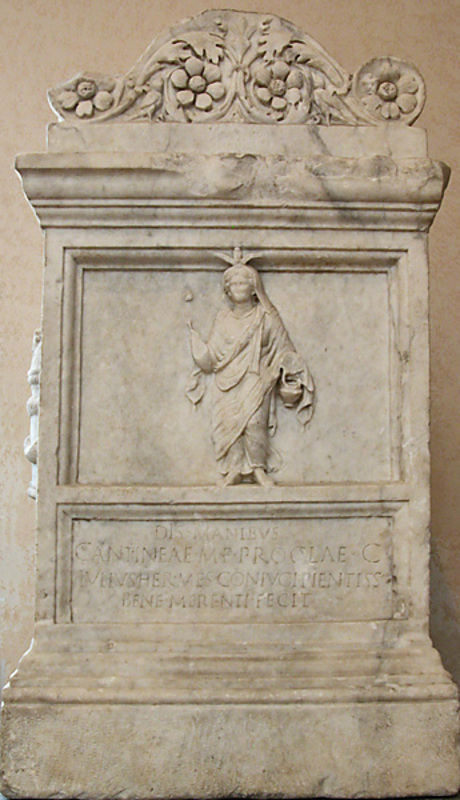
Inscription: To the spirits of the dead: Gaius Julius Hermes set up [this monument] for Cantinea Procla, daughter of Marcus, his most devout and well-deserving wife
Cantinea (no relation to the one memorialized in the epitaph above) would have sooner been remembered more for her dutiful acts to her husband and children than for her contributions to her temple or community as a whole. Her acts as a priestess—and as a woman separate from her family—get silenced by the choices of her husband, yet her identity as a priestess is visually memorialized. This creates a gap between what is written and visually depicted: Cantinea is almost immediately identifiable as a priestess of Isis due to her depiction, but no mention of Isis is made in the inscription itself.
Iconography depicting followers of the Cult of Isis mostly follows a similar formula. A follower will be wearing ceremonial garments, and the depiction will have at least two of these three elements present: a sistrum (rattle), the “Isis knot” (a knotted portion of the ceremonial robes over the chest), or a situla (a small vase likely used in libation rituals) as these are the three most common visual signifiers of involvement in the Cult of Isis (Martzavou, 71). The inclusion of these elements on a figure is believed to signify a person’s involvement within the Cult of Isis to a modern eye.
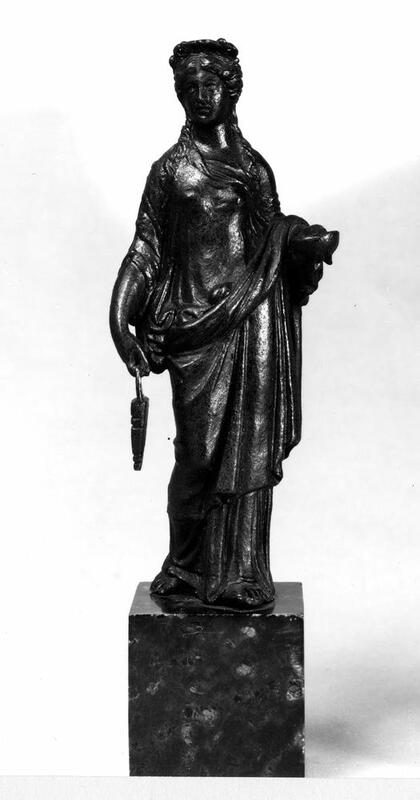
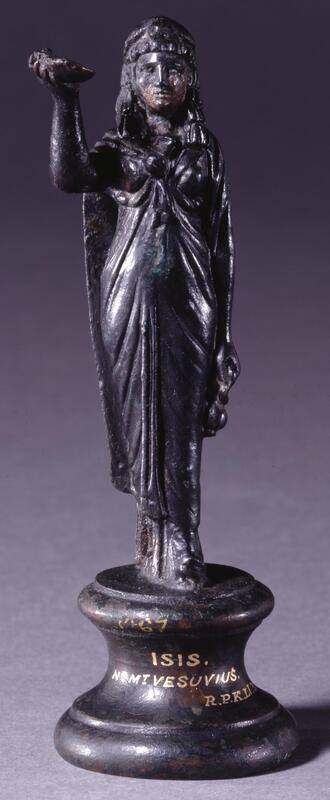
These figures illustrate the details that make up a physical representation of followers of the Cult of Isis while also offering small clues as to what participation in the Cult would have entailed. Figure Two includes depictions of the sistrum and ceremonial garments, while Figure Three includes the “Isis knot” over the chest of the figure, a situla, and a patera (a small shallow bowl likely used for libations) (British Museum, 2022).
As part of her position as the donation and banquet overseer, is it plausible to believe Cantinea could have been a Pompeiian version of the Delian kanephoroi, or basket-bearing woman. Cantinea would have likely had a role carrying baskets during ritual processions but also would have had other roles in carrying out rituals within the temple, likely surrounding the donation table and use of the situla (Martzavou, 72, 74). The processions she would have been a part of would have been highly public events, and thus, Cantinea would have been made highly visible to bystanders both involved and uninvolved with the Cult (Mazurek, 219).
Cantinea would likely have interacted with people from many different backgrounds as part of her duties including a class that historically is overlooked: slaves. A facet of dedication to Isis was the practice of manumission, the process of releasing a person from slavery through the enslaved person’s acts or payments. Within the Cult of Isis, slaves were promised legal freedom in exchange for hard labor (Strabley). This process, while potentially leading to the release of people from slavery, would have continued the cycle of forced slave labor that the Roman Empire relied on. It is important to note that while groups like the Cult of Isis could have been advantageous for women who wanted a more active role within their religion, it also still participated in imperial industries and was not automatically a place where everyone would have been treated equally.
Cantinea’s Story as Seen in the Modern Era
Modern depictions of the Roman Empire project an image of a pantheon of powerful and vengeful gods. These depictions of their culture, however, do nothing to acknowledge the broader religious beliefs and practices that existed within the Roman Empire. As the empire expanded, so did the cultures that would have been able to influence each other, whether directly or indirectly. As Egyptomania (the obsession with Egyptian culture within European cultures) expanded in Roman society, the Cult of Isis, a cult dedicated to an Egyptian deity, rose in popularity. Though there is surviving evidence of the cult’s presence, it is rarely mentioned in most modern mainstream content about religion in the Roman Empire.
As it is, most evidence surviving today of the Cult of Isis in the Roman world is visual in nature or created by men as a way of memorializing women’s roles as wives and mothers while not giving any true details into their lived experiences. This renders the lives and work of these women visible yet still invisible: we can see what these women would have dressed like when performing religious duties, and we can see the items and symbols that would have been important and sacred to them, but we cannot know the deeper details of their lives and the way they carried out their religious duties. We also cannot know the nature of these women’s relationships with Isis or any other deities they would have felt a connection to.
Though Cantinea Procla is not a true historical figure, and the inner workings of her life can never truly be known, she serves as a model through which themes of religion, gender, and inequality within the Roman Empire can be examined.
Sources and Further Reading
- Butler, H. The Cult of Isis and Early Christianity. University of Hawaii.
- Martzavou, P. (2011). Priests and Priestly Roles in the Isaic Cults. Women as Agents in.
- Mazurek, L. A. (2023). Building Outside the Lines: Networks, Women’s Agency, and Euergetism in the Egyptian Cults, Memoirs of the American Academy in Rome, 68, 210-254. https://www.jstor.org/stable/10.2307/27271679
- Sirkovsky, L. (2016). A Foreign Goddess The History of the Cult of Isis (Publication No.260339615). [Master’s Thesis, McGill University]. ProQuest Dissertations & Theses.
- Strabley, E. Temple of Isis at Pompeii. Connecticut College. https://openpress.digital.conncoll.edu/religionsofgreeceandromesitereports/chapter/temple-of-isis-at-pompeii/
- Tully, C. (2008). The Reception of the Cult of Isis in Rome from the Late Republic to the Flavian Dynasty (Publication No. 20190802). ProQuest Dissertations Theses.